

See more details about this topic in the following article. This Freelancer From Vietnam Earns More Than Silicon Valley Engineers
This Freelancer From Vietnam Earns More Than Silicon Valley Engineers
The year is 2026, and the geographical premium on talent has officially collapsed. For decades, the “Silicon Valley Tax” was a standard business cost—the price of admission to access the world’s most elite engineering minds. But as global connectivity has hit a tipping point and AI has leveled the playing field, a new class of “Super-Freelancers” has emerged from the tech hubs of Hanoi and Ho Chi Minh City.
Meet “Duy,” a 29-year-old AI Integration Architect based in Da Nang. Duy doesn’t work for Google, Meta, or OpenAI. He doesn’t have a commuter pass for the Caltrain or a $4,000 studio apartment in Palo Alto. Yet, his 2026 tax return shows a net income of $485,000 USD—surpassing the total compensation of many Senior Staff Engineers at top-tier Silicon Valley firms.
Duy isn’t an anomaly; he is the face of the “Vietnam Tech Surge,” a movement that has turned the Southeast Asian nation into the world’s premier destination for high-complexity AI and automation.

The “Human-in-the-Loop” Gold Mine
To understand how a freelancer in Vietnam can out-earn a Silicon Valley veteran, we have to look at the Shift in Complexity. In 2026, basic coding is a commodity. AI writes the boilerplate, handles the debugging, and manages the documentation. The value has shifted from “writing code” to “Architecting Intelligence.”
Duy’s specialty is building “System-Level Autonomy.” He doesn’t just build apps; he builds self-correcting neural workflows for multi-billion dollar manufacturing firms in Germany and logistics giants in Singapore. While a Silicon Valley engineer might be restricted to a single feature within a massive corporate hierarchy, Duy acts as a Fractional CTO for three different international firms simultaneously.
The Math of Global Arbitrage
- Silicon Valley Senior Engineer (2026): ~$250,000 Base + $150,000 Stock (often illiquid) = $400,000 Total.
- Vietnam Super-Freelancer (2026): $150/hr x 50 hours/week x 48 weeks = $360,000 Cash.
- The “Retainer” Bonus: Most elite Vietnamese freelancers now operate on Value-Based Retainers. Duy charges a “Maintenance & Optimization” fee of $10,000/month per client. With three major clients, that’s an additional $360,000/year.
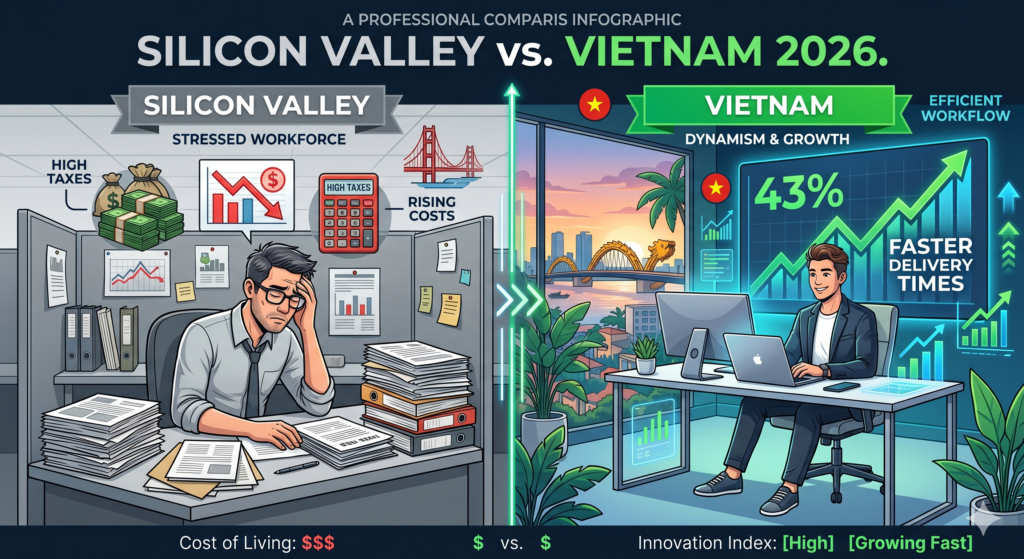
When you subtract the 10% – 20% tax rate in Vietnam versus the 40%+ tax burden in California, the “take-home” winner is clear.
Why Vietnam? The 2026 Talent Advantage
Silicon Valley remains a hub of innovation, but it has become bogged down by its own success. Hiring in the US in 2026 involves navigating non-compete clauses, astronomical recruitment fees, and a culture of “rest-and-vest.”
Vietnam, conversely, has leaned into a “Velocity Culture.”
1. The STEM Heritage
Vietnam’s education system has been obsessed with mathematics and computer science for a generation. By 2026, the country produces 15,000 specialized AI/ML graduates annually. Unlike generalists, these engineers are trained in “Deep Tech”—computer vision for factories, predictive maintenance for infrastructure, and NLP for borderless commerce.
2. The “Factory Floor” Perspective
Because Vietnam is a global manufacturing hub, its developers have a unique edge over “Pure Software” engineers in the West. Duy’s most lucrative project was an AI system that reduced downtime for a garment factory by 34%.
“A Silicon Valley engineer understands the cloud,” Duy says. “But I understand how the cloud talks to a physical machine on a factory floor. That is where the real money is in 2026.”
The Secret Sauce: The “Fractional” Business Model
The shocking truth about Duy’s income is that he isn’t “working” more than a Valley engineer. In fact, he works less. The secret lies in the Fractional Model.
In the old world of 2023, you hired a developer. In 2026, you hire Outcome-as-a-Service. Duy doesn’t bill for hours spent typing; he bills for the reduction in operational costs he delivers.
A Day in the Life of a $500k Freelancer:
- 08:00 – 10:00: Deep Work (Da Nang). Auditing autonomous AI agents for a London-based fintech firm.
- 10:00 – 12:00: Consulting. Helping a Singaporean startup secure their Series B by proving their AI-to-Data bridge is unhackable.
- 14:00 – 16:00: R&D. Fine-tuning a private Llama-4 model on a client’s proprietary dataset.
- Evening: Asynchronous communication with US East Coast clients via Slack and Notion.
By operating as a “one-person agency,” Duy captures the profit margin that used to go to middle management and corporate office leases.
The “Vietnam Premium” vs. The “Silicon Valley Tax”
For the first time, Western companies are paying a “Vietnam Premium.” This is the cost of securing a specialist who can ship an accurate machine learning model 43% faster than a local US team.
| Metric | Silicon Valley (Senior) | Vietnam (Elite Freelancer) |
| Annual Take-Home | ~$220,000 (Post-Tax) | ~$410,000 (Post-Tax) |
| Time-to-Market | 12-16 Weeks | 6-8 Weeks |
| Operational Focus | Corporate Alignment | Direct Business ROI |
| Technical Depth | Specialized (Siloed) | Cross-Functional (Architect) |
How You Can Compete in the Global Talent War
The story of Duy is a warning to those who rely on a zip code to justify their salary. In 2026, the market only cares about two things: Time to Result and Accuracy of Integration.
If you are a freelancer looking to replicate Duy’s success, the roadmap is clear:
- Escape the “Task” Mindset: Stop being a “coder” and start being a “Solution Architect.”
- Master the “Physical-Digital” Bridge: Learn how software impacts physical industries (logistics, manufacturing, energy).
- Build a “Proof of Human” Portfolio: Use verified case studies where you managed AI to achieve a 10x result.

Conclusion: The New World Order
As we reach the middle of 2026, the “Silicon Valley” isn’t a place anymore—it’s a mindset. But that mindset has moved East. Duy, sitting in a Da Nang cafe with a high-speed satellite link and a suite of custom-trained AI agents, is the new standard of tech success.
He doesn’t want a job in California. Why would he? He’s already winning the game from home.
Leave your comment