
Read this article to learn more about this topic,How Remote Hiring Is Transforming Global Business
How Remote Hiring Is Transforming Global Business
The traditional corporate headquarters is undergoing a massive structural shift. The global labor market has entered a mature, highly performant era of decentralized workforce architecture. What began as an emergency response to global disruptions has stabilized into a calculated corporate strategy: the implementation of direct-to-talent borderless hiring pools.
For decades, organizations restricted their executive search and technical recruitment to localized talent radii—typically within a 50-mile commuting zone of an urban office. This localized constraint forced companies into fierce domestic wage wars, high real estate overheads, and a reliance on a limited local skills pool.
In 2026, forward-thinking enterprises are discarding geographic limitations. By shifting from a localized hiring model to a globally distributed network, businesses are transforming their operational cost structures, accelerating their development velocity, and building an unshakeable competitive advantage.
1. The Global Arbitrage: Decoupling Talent from Geography
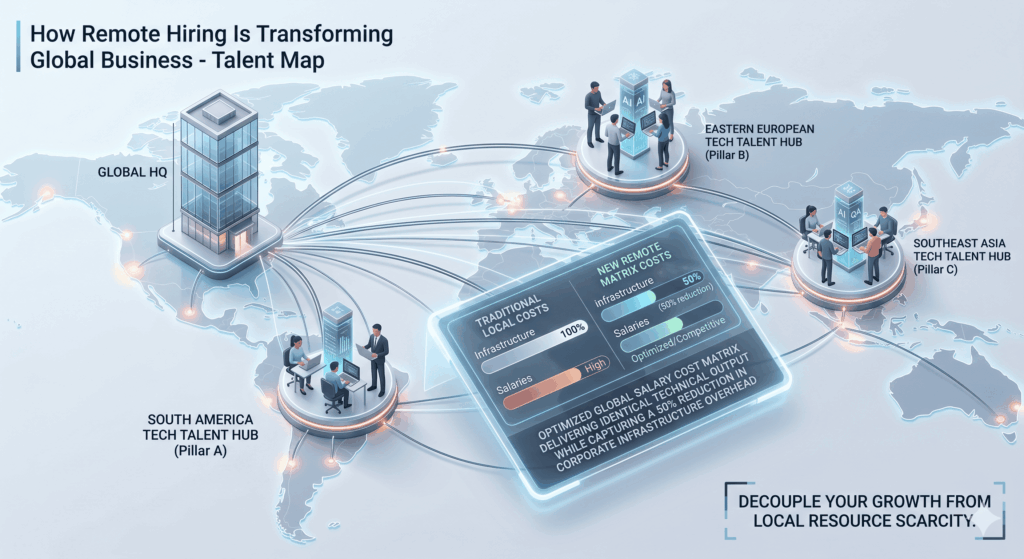
The primary driver accelerating global remote hiring is the radical optimization of human capital costs, commonly known as Talent Arbitrage.
Historically, to hire a top-tier Senior AI Integration Engineer or full-stack software architect in Silicon Valley, New York, or London, corporations had to absorb massive compensation packages. These packages didn’t just pay for the individual’s technical skill; they heavily subsidized the astronomical real estate and living costs of those specific cities.
By utilizing global remote hiring pipelines, enterprises decouple compensation from localized inflation.
[Traditional Localized Hiring] ➔ High Salary + Subsidized Local Real Estate Overhead
[Modern Borderless Hiring]     ➔ Optimized Salary Adjusted to Regional High-End Value
An organization can source an equally skilled, elite machine learning specialist or full-stack developer based in a rising technical hub like Bengaluru (India), Warsaw (Poland), or Ho Chi Minh City (Vietnam). The company can offer a salary that is highly competitive within that regional market—placing the professional in the top 1% of local earners—while saving up to 40% to 60% in total employee compensation overhead compared to an on-site domestic hire.
2. Operating a Follow-the-Sun Operational Model
Traditional businesses operate on a synchronous, linear 8-hour workday. When the office lights turn off at 5:00 PM in Chicago or London, product development stops, customer support queues stall, and system monitoring enters a passive, high-risk state.
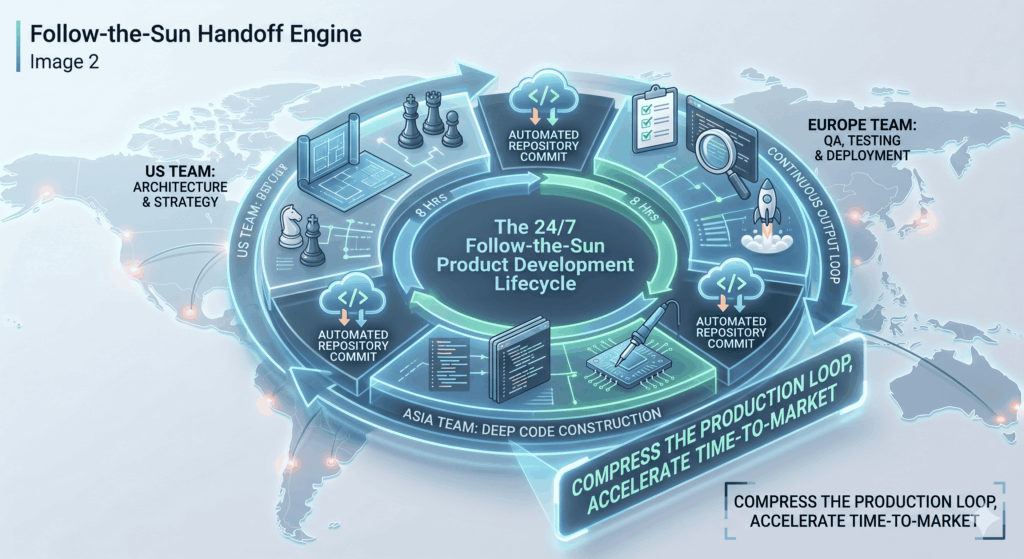
Global remote hiring allows companies to build a continuous, 24/7 Follow-the-Sun Operational Cycle.
By strategically distributing teams across distinct regional time zones (such as North America, Western Europe, and Asia-Pacific), the output of an enterprise becomes continuous.
[US Team: 9 AM - 5 PM] ➔ Handover ➔ [Asia Team: 9 AM - 5 PM Local] ➔ Handover ➔ [Europe Team: 9 AM - 5 PM Local]
When a software development team in San Francisco concludes their evening sprint, they execute a clean code handoff via structured repositories to an incoming engineering team in Vietnam or India. While the Western team sleeps, the Eastern team continues building, testing, and debugging. This time-zone distribution effectively compresses a traditional 3-week development loop into a 1-week cycle, drastically accelerating time-to-market.
3. The Move to Asynchronous Flow States
You cannot successfully manage a globally distributed team using legacy, synchronous management tactics. Forcing a remote employee in Southeast Asia or Eastern Europe to sit on a 10:00 PM alignment call just to prove presence destroys employee retention and fragments focus.
The rise of global hiring has forced an evolution toward Asynchronous Management Structures.
Organizations are trading real-time slack pings and endless Zoom meetings for structured, highly transparent documentation.
- The Documentation Core: Teams rely on deep-dive knowledge bases (such as Notion, Linear, or GitHub Enterprise) where every project parameter, system architecture change, and strategic decision is exhaustively documented.
- The Explainer Interface: Instead of demanding a live meeting, developers and project managers communicate complex updates via 2-to-3-minute Loom video walk-throughs. The receiving team reviews the material at the start of their specific workday, executes the necessary actions, and records an async response.
This shift removes communication clutter and creates massive blocks of uninterrupted Deep Work Time, allowing engineers and creatives to execute complex projects without administrative drag.
4. The Institutionalization of Global Compliance Networks
Historically, the single largest operational blocker preventing legal teams and HR executives from scaling remote hiring was global regulatory compliance. Onboarding an independent contractor or full-time employee in a foreign country meant navigating complex local labor laws, international tax withholding protocols, and foreign entity registration.
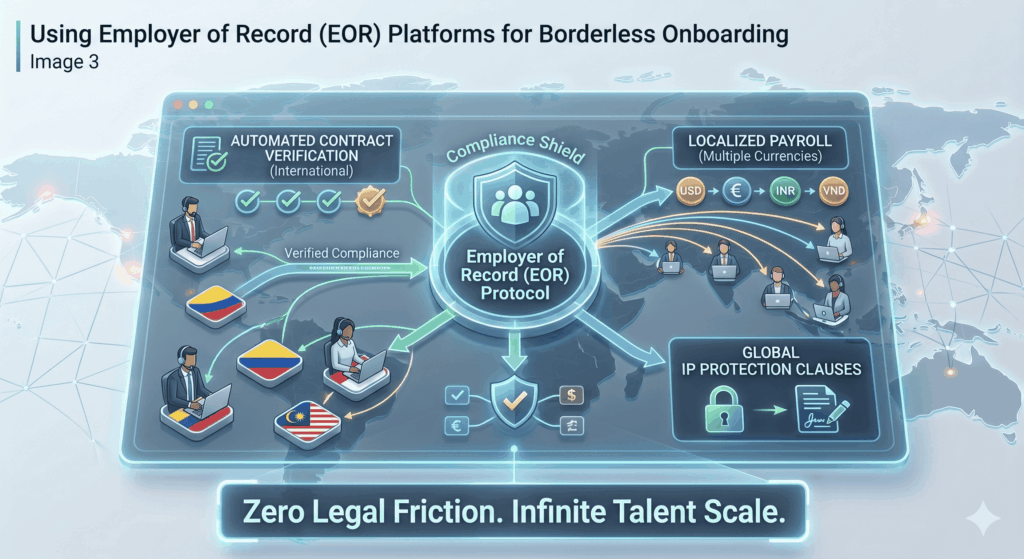
This barrier has been completely dismantled by the institutionalization of Employer of Record (EOR) global compliance networks.
Platforms like Deel, Remote, and Oyster function as a centralized compliance shield. The EOR platform acts as the legal employer on the ground in the foreign country, managing localized payroll, mandatory benefits package allocations, IP protection protocols, and local tax compliance.
[Your Enterprise] ➔ Contracts ➔ [Global EOR Platform] ➔ Handles Payroll & Local Taxes ➔ [Global Remote Talent]
This structural innovation allows a company based in Delaware or Berlin to source, hire, and legally onboard an elite developer in Colombia or Malaysia in under 48 hours, entirely eliminating international legal friction.
5. Cultural Agility and Hyper-Localized Market Access
When a company restricts its hiring pool to a single geographic area, it inadvertently builds a cultural echo chamber. This lack of diversity severely limits the company’s ability to localize products, enter international markets, or understand foreign consumer behavior.
Global remote hiring acts as an organic International Growth Engine.
By embedding remote professionals directly into diverse international target markets, an enterprise gains instant, hyper-localized insights. A distributed marketing team with specialists stationed across Latin America, the Middle East, and Asia-Pacific can launch highly nuanced, culturally compliant regional ad campaigns simultaneously.
They understand the nuances of local payment gateways, regional social networks, and localized UI/UX preferences, enabling the business to scale its global footprint with unmatched precision.
Conclusion: The Sovereign Organization
The transformation of global business through remote hiring is not a temporary trend; it is an irreversible evolution of corporate architecture. Companies that continue to insist on localized, synchronous, on-site employment are placing an artificial ceiling on their growth—restricting their talent quality, inflating their operational overhead, and slowing their execution speeds.
The sovereign organization of 2026 is borderless by design. By leveraging global talent arbitrage, mastering asynchronous workflows, utilizing EOR frameworks, and running continuous operational cycles, distributed businesses are building a highly agile corporate model designed to dominate the modern digital economy.
Leave your comment