

See more details about this topic in the following article.Why Entrepreneurs Are Building Global Teams Across Asia
Why Entrepreneurs Are Building Global Teams Across Asia
The entrepreneurial landscape of 2026 has officially outgrown the “local hire” philosophy. For decades, the dream of building a startup was tethered to a physical location—a garage in Palo Alto, a basement in Shoreditch, or a co-working space in Berlin. But as the cost of living in Western tech hubs reaches an unsustainable peak and the demand for specialized technical talent outstrips local supply, a new paradigm has emerged.
Today, the most successful entrepreneurs aren’t just looking for employees; they are building Distributed Global Engines. And the heart of these engines is beating in Asia.
From the AI corridors of Bengaluru to the high-velocity development hubs of Ho Chi Minh City and the strategic financial centers of Singapore, Asia has become the indispensable foundation for the modern global startup. Here is a deep dive into why entrepreneurs are aggressively shifting their focus to the East and how this strategy is defining the winners of 2026.

1. The Death of the “Geographic Discount” and the Rise of “Value-Efficiency”
In the early 2020s, hiring in Asia was often seen through a single lens: cost. It was about finding someone to do the job for 70% less. In 2026, that mindset is obsolete. Entrepreneurs have realized that the real advantage isn’t “cheap labor”—it is Value-Efficiency.
The Math of 2026 Talent
In a Western hub like New York, a Senior AI Engineer might command a salary of $280,000, with an additional 30% in overhead (benefits, office space, insurance). However, that engineer is often bogged down by domestic distractions, high turnover, and “corporate bloat.”
In contrast, an entrepreneur can hire an elite AI Integration Architect in Vietnam or India for $120,000–$150,000. While the salary is lower in absolute terms, the “output-per-dollar” is exponentially higher. These professionals are often more specialized, work with a “velocity-first” mentality, and utilize AI-augmented workflows that allow them to ship code 40% faster than their domestic counterparts.
“I’m not hiring in Asia to save a buck. I’m hiring there because the engineer in Da Nang is solving problems in two days that my London team was debating in meetings for two weeks.” — Founder of a 2026 AgTech Startup.
2. The 24-Hour “Follow-the-Sun” Productivity Cycle
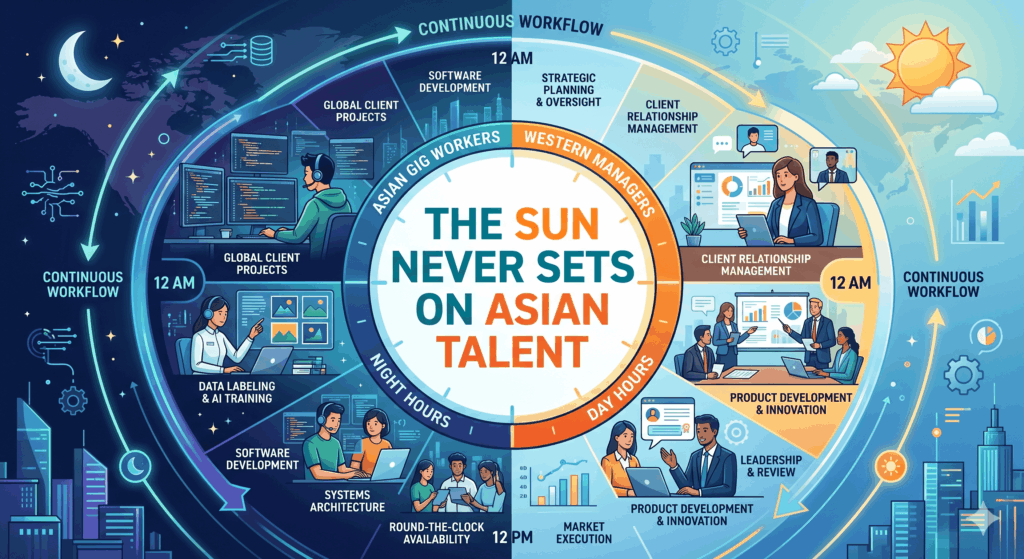
In the high-stakes world of 2026 startups, speed to market is the only moat. If you aren’t shipping features weekly, you are dying. Entrepreneurs are building global teams across Asia to unlock the Follow-the-Sun model—a perpetual motion machine for productivity.
The Cycle in Action
Imagine an entrepreneur based in Austin, Texas.
- 5:00 PM (Austin): The local team finishes their day, pushes their latest updates to GitHub, and leaves a Loom video detailing the next set of blockers.
- 7:00 AM (Vietnam/India/Singapore): The Asian team logs on. They don’t just “start their day”; they pick up exactly where the US team left off.
- 5:00 PM (Asia): The Asian team pushes the completed features and runs the automated QA tests.
- 8:00 AM (Austin): The founder wakes up to a fully updated product.
This isn’t just “extra help.” This is a doubling of the development runway without doubling the burn rate. For a startup with 18 months of runway, the Follow-the-Sun model effectively gives them 36 months of development progress.
3. Radical Specialization: Beyond the Generalist
Western markets are currently suffering from a “Generalist Overload.” Many domestic developers are proficient in basic full-stack work but lack the deep, niche expertise required for the 2026 economy. Asia, however, has leaned into Hyper-Specialization.
Centers of Excellence
Entrepreneurs are shopping for specific “Skill Hubs” across the continent:
- Vietnam: The global capital for No-Code/Low-Code and AI-Workflow Integration.
- India: The undisputed leader in MLOps (Machine Learning Operations) and large-scale backend architecture.
- The Philippines: The hub for UX/UI Research and AI-Human Interaction (ensuring AI systems don’t feel “robotic”).
- Singapore: The strategic anchor for Fintech, Blockchain Security, and ESG Compliance.
By building a distributed team, an entrepreneur can cherry-pick the world’s best specialist for each specific department rather than settling for the “best person available within a 50-mile radius.”
4. The Stability of the “New Middle Class”
As discussed in our earlier coverage, remote work has created a massive, stable middle class in Asia. For an entrepreneur, this translates to unparalleled loyalty and retention.
In Silicon Valley, the average tenure for a developer is often less than 18 months—engineers are constantly “poached” by the next big unicorn. In contrast, an elite freelancer in a hub like India or Vietnam who is earning a “Global Wage” while living in their home community is highly incentivized to stay.
They are building their lives around your company. This stability allows entrepreneurs to build Institutional Memory—a rare and valuable asset in the volatile startup world.

5. Overcoming the “Culture Gap” with AI and Async
The traditional argument against global teams was the “Culture and Communication Gap.” In 2026, technology has effectively neutralized these concerns.
The Tools of the Global Entrepreneur
- Real-Time AI Translation: Tools integrated into Slack and Zoom now handle linguistic nuances in real-time, ensuring that “intent” is never lost in translation.
- Async-First Protocols: Successful entrepreneurs have abandoned the “meeting-heavy” culture in favor of documentation-first platforms like Notion and Linear.
- Cultural Fusion: Founders are finding that the “Velocity Culture” of Asia—characterized by a high work ethic and a desire to prove oneself on the global stage—is a perfect match for the “Hustle Culture” of a startup.
6. The Strategic Multiplier: Market Entry
Building a team in Asia isn’t just about building the product; it’s about owning the market. Asia represents 60% of the world’s population. By having a team on the ground in Singapore, Jakarta, or Mumbai, an entrepreneur gains instant market intelligence.
These team members aren’t just employees; they are cultural consultants. They understand the local payment gateways, the nuances of consumer behavior in the region, and the regulatory hurdles that would baffle a Western-only team. For a startup looking to “go global,” their Asian team is their most effective scouting party.
7. Conclusion: The Borderless Mandate
The entrepreneurs who are winning in 2026 are those who have realized that talent has no zip code. They aren’t “outsourcing”; they are globalizing.
By building teams across Asia, they are accessing a level of technical rigor, a cycle of 24/7 productivity, and a depth of specialization that is simply unavailable in the West. The “Shocking Truth” is that the next “Silicon Valley Unicorn” will likely have a founder in New York, a lead architect in Da Nang, and a data team in Bengaluru.
The world is flat, the tech is ready, and the talent is in Asia. For the modern entrepreneur, the question is no longer “Why build a global team?” but rather, “How can I afford not to?”
Leave your comment