
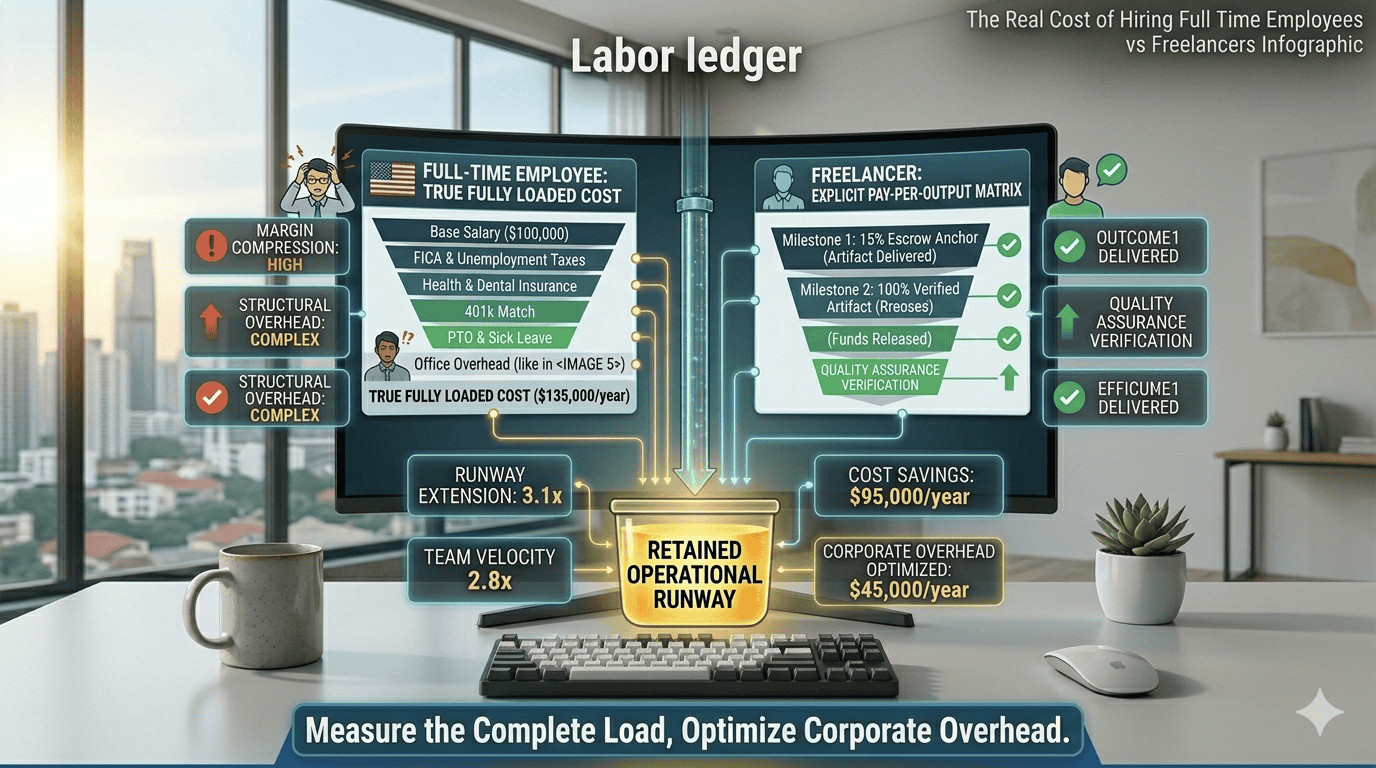
The Real Cost of Hiring Full-Time Employees vs Freelancers
Every executive and startup founder knows the core dilemma of building a workforce: Should we hire a full-time employee (FTE) or bring on an independent freelancer?
The decision is too often reduced to a surface-level comparison of a salaried line-item against a freelancer’s hourly rate. At first glance, a senior developer demanding $120 per hour looks significantly more expensive than an in-house employee with a base salary of $130,000 a year (which scales down to roughly $65/hr).
This math is incomplete and fundamentally flawed. Legacy accounting structures often obscure the true financial weight of employment. To make an accurate strategic decision, you must calculate the Fully Loaded Cost Factor.
When you account for mandatory payroll taxes, benefit allocations, recruitment friction, and non-productive time, an in-house employee costs vastly more than their base salary. Conversely, while freelancers have a higher nominal hourly cost, they allow for massive structural cost de-escalation because you only pay for raw, delivered output.
This financial analysis breaks down the true hidden cost structures of full-time employees versus independent contractors, providing the exact calculus required to build a lean, high-velocity organization.

1. The Anatomy of the FTE: The 1.35x Multiplier Rule
According to data from the U.S. Small Business Administration (SBA) and corporate labor metrics, the true cost of a full-time employee typically ranges from 1.25 to 1.4 times their base salary—averaging out to a 1.35x fully loaded multiplier.
When you commit to a $130,000 software engineer, marketing director, or system architect, you aren’t writing a check for $130,000. You are committing your enterprise to an actual baseline expenditure closer to $175,500.
The Hidden Overhead Stack:
- The Payroll Tax Burden: Employers are legally bound to cover non-negotiable tax contributions. In the U.S., this includes matching Social Security (6.2% up to the wage ceiling), Medicare (1.45%), Federal Unemployment Insurance (FUTA), and State Unemployment Insurance (SUI). This adds an immediate 7.65% to 10% cash overhead on top of the base wage.
- Health and Welfare Benefit Allocations: Providing enterprise-grade health, dental, and vision insurance coverage, alongside life insurance and short-term disability policies, requires heavy capital deployment. Averaged out across corporate tiers, benefits add an additional $10,000 to $25,000 annually per full-time employee.
- Retirement Matches: Standard competitive corporate environments require a 401(k) or pension match framework—typically averaging 3% to 5% of the gross salary. On a $130,000 base, this pulls an extra $3,900 to $6,500 out of your cash flow every year.

2. The Drag of Non-Productive Time
The single biggest financial leak in traditional employment models is paying for Unutilized Hours. When you hire a full-time employee, you buy 2,080 hours of their time per year (40 hours/week × 52 weeks). However, an employee never delivers 2,080 hours of actual business production.
The Breakdown of Paid Inactivity:
[Available Year: 2,080 Hrs] ➔ Paid Leave (-160 Hrs) ➔ Administrative Drag (-300 Hrs) = [True Production: ~1,620 Hrs]- Paid Time Off (PTO) & Sick Leave: A standard professional benefits package includes a minimum of 3 weeks of paid vacation, 5 paid sick days, and roughly 10 federal/public holidays. This represents approximately 20 to 25 days of paid absence. At a $130,000 salary, your organization pays roughly $11,500 to $13,000 annually for zero operational output.
- The Internal Administrative Tax: Bureau of Labor Statistics data indicates that the average in-house employee is truly productive for roughly 2.5 to 3 hours out of a standard 8-hour day. The remainder of the billable block is consumed by internal administrative drag: non-essential alignment syncs, casual office socialization, mandatory corporate compliance modules, and internal communication clutter.
The Freelancer Contrast: Independent freelancers carry an automatic 100% Billable Utilization Rate. They do not receive paid vacation, sick leave, or holiday bonuses from your firm. If an international developer takes a two-week holiday, your payroll drops to zero. You compensate them strictly for micro-deliverables achieved, code blocks committed, or specific project milestones pushed to production.
3. Recruitment, Equipment, and the Friction of Severance
The financial liabilities of full-time employment extend far beyond the monthly payroll sequence. Sourcing and offboarding in-house staff brings massive friction costs.
- The Acquisition Premium: Sourcing top-tier specialized talent in a competitive domestic landscape is expensive. Between job board advertising fees, background check screening runs, internal HR processing time, and potential third-party recruiting agency placement commissions (often 15% to 20% of first-year salary), the fully loaded cost of acquiring a new senior employee averages $15,000 to $40,000.
- Hardware and Remote Stipends: To stay regulatory-compliant and ensure data security, enterprises must purchase and provision dedicated hardware (enterprise laptops, external monitors, secure communication items) and provide remote-work stipends. Prorated workspace equipment costs average $2,500 to $5,000 per user account.
- The Severance and Restructuring Risk: If market conditions shift or an employee fails to perform, offboarding an FTE is a financial and legal minefield. Companies must absorb the expense of severance packages (frequently 1 to 3 months of pay), handle rising unemployment insurance premiums, and face potential wrongful termination legal challenges. Freelancers require zero severance outlays; if a contract reaches its logical conclusion or priorities change, you simply terminate the project agreement with zero lingering structural liability.
Step-by-Step Cost Calculus: The Real-World Scenario
To illustrate the stark mathematical contrast, let’s look at a concrete case study: Hiring a Senior Software Engineer / Full-Stack Product Architect.
We will contrast an in-house U.S. domestic employee at a market-rate salary of $140,000/year against a highly specialized international freelancer charging a premium rate of $80/hour working an equivalent schedule of roughly 1,800 active production hours.
The FTE vs. Freelancer Spending Ledger
| Expense Component | Full-Time Employee (In-House) | Independent Freelancer ($80/hr) |
|---|---|---|
| Base Compensation / Earned Billables | $140,000 | $144,000 |
| Mandatory Payroll Taxes (FICA/FUTA/SUI) | $11,200 | $0 |
| Corporate Health, Dental, & Vision Plans | $16,500 | $0 |
| 401(k) Retirement Match (4%) | $5,600 | $0 |
| Paid Leave Amortization (PTO/Holidays) | $12,350 | $0 |
| Recruitment, Vetting, & Onboarding | $25,000 | $9.99 |
| Hardware, Stipends, & Software Seats | $4,500 | $0 |
| Platform Marketplace Fees (Client Side) | $0 | $7,200 |
| TOTAL ONE-YEAR OUTFLOW | $215,150 | $151,209 |
| TRUE EFFECTIVE HOURLY PRODUCTION RATE | $119.53 / Hour | $84.00 / Hour |
The Critical Takeaway:
Even though the freelancer’s nominal hourly rate ($80) looks significantly higher than the employee’s base hourly break ($67.30), the Fully Loaded FTE cost climbs to nearly $120 per production hour. Sourcing the independent professional results in an immediate $63,941 in baseline capital retention in year one alone—extending your company’s operational runway.

4. Strategic Alignment: Matching Your Business Variant to the Correct Model
While the quantitative data leans heavily toward independent talent, choosing between an FTE and a freelancer requires analyzing your specific Operational Bottleneck.
                           ┌───────────────────────────┐
                           │    WORKFORCE SELECTION    │
                           └─────────────┬─────────────┘
                                         │
                  ┌──────────────────────┴──────────────────────┐
                  ▼                                             ▼
       [FULL-TIME EMPLOYEES]                         [INDEPENDENT FREELANCERS]
 • Core Brand Identity Assets                  • Technical Execution Sprints
 • High-Trust Executive Leadership             • Specialized Domain Expertise
 • Proprietary IP Systems Architects            • Fluid Scaling Agile Projects
When to Absorb the FTE Multiplier:
You should pay the employment premium exclusively for roles that act as your company’s core foundation. This includes your C-suite executives, high-trust project managers who control core operations, and engineers architecting your proprietary, non-negotiable intellectual property. These roles require deep company integration and permanent commitment.
When to Leverage Freelance Arbitrage:
You should shift to a flexible freelance model for any role indexed to execution, production sprints, or specialized domains. If you need a website redesigned, an AI model fine-tuned, a targeted marketing campaign deployed, or technical quality assurance (QA) automation built, hiring an FTE introduces long-term structural drag. Freelancers allow you to source elite global expertise instantly, execute at hyper-speed, and scale your labor costs down to zero the moment the project goal is achieved.
Conclusion: The Capital Efficiency Mandate
The decision to build a distributed network of independent freelancers rather than accumulating a high local employee headcount is ultimately a design problem. Legacy organizations measure their status by headcount; modern, agile organizations measure their status by Revenue Per Employee and Capital Runway Multiplier.
By aggressively stripping away mandatory tax overheads, benefits management drag, unutilized paid leave blocks, and recruitment agency markup fees, you build a lean, asset-light corporate entity. Geographic and operational arbitrage allow you to direct your capital away from internal infrastructure and funnel it into market growth—enabling your business to out-scale and out-execute your competitors with absolute financial precision.
Leave your comment