
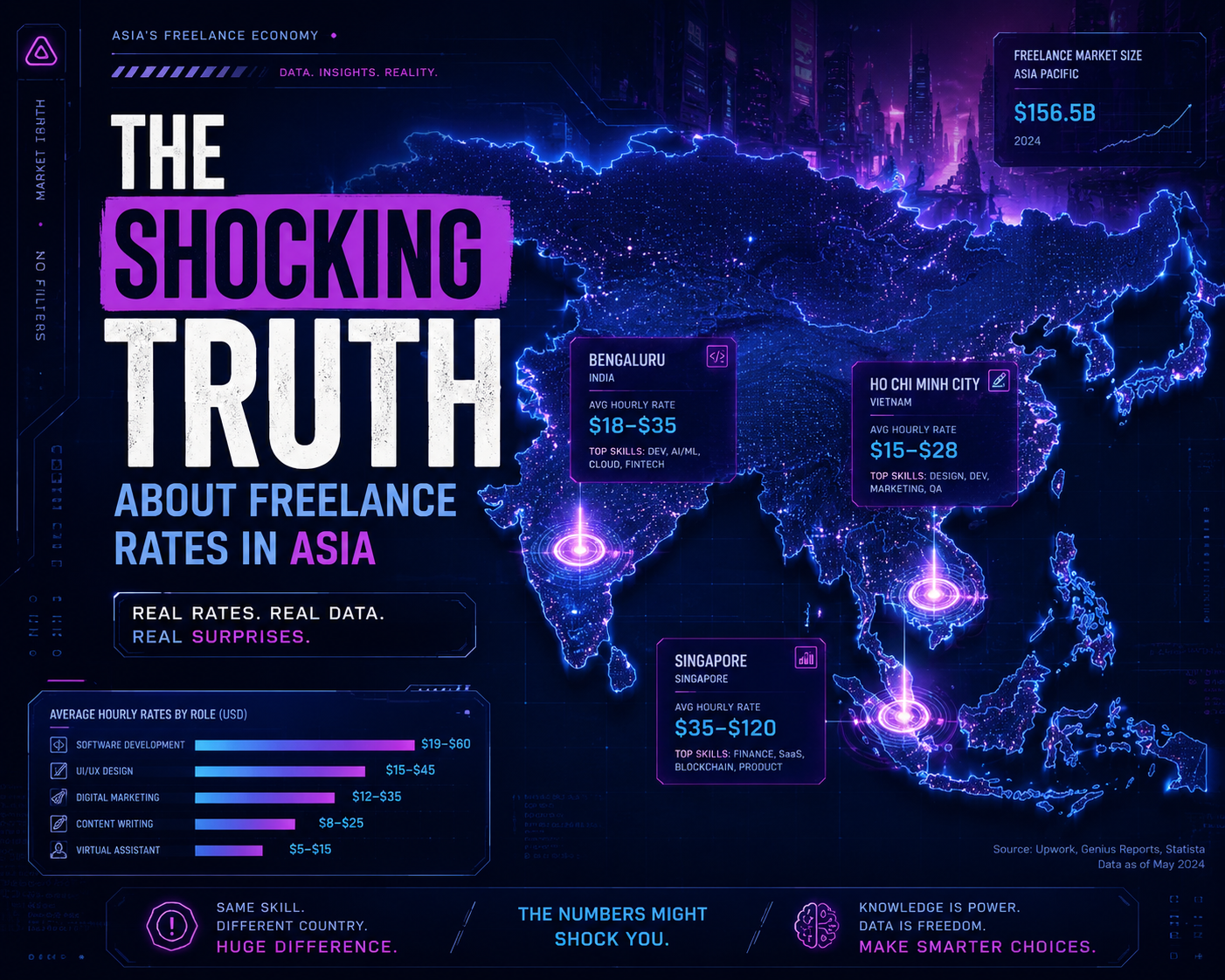
See more details about this topic in the following article The Shocking Truth About Freelance Rates in Asia.
The Shocking Truth About Freelance Rates in Asia: Why the “Cheap Labor” Myth is Dead in 2026
For decades, the global business narrative regarding Asia was built on a single, unwavering pillar: cost-cutting. If a Western company needed a website, a mobile app, or a customer service team, they looked to the East to slash their operational expenses by 70% or more. The term “outsourcing” became synonymous with “budget-friendly.”
But as we navigate the landscape of 2026, a massive structural shift has occurred. If you enter the Asian freelance market today expecting 2010-era prices for 2026-level technical problems, you aren’t just in for a surprise—you’re in for a total shock.
The “Shocking Truth” is that Asia is no longer the world’s back office; it is the world’s R&D department. From the AI hubs of Bengaluru to the fintech clusters in Singapore and the automation labs of Ho Chi Minh City, freelance rates are skyrocketing. In many niches, Asian specialists are now out-earning their European and American counterparts.

Part I: The Death of the $5 Hourly Rate
The most immediate shock for traditional “outsourcers” is the disappearance of the low-tier freelancer. In 2026, the $5-per-hour data entry clerk or basic “WordPress dev” has been effectively replaced by autonomous AI agents.
In the past, a business might hire five freelancers in the Philippines to manually categorize data. Today, a single $150/month subscription to an Enterprise LLM does that work in seconds. Consequently, the “bottom” of the market has fallen out. What remains is a highly skilled, highly specialized workforce that knows their worth.
The New Floor
In high-growth Asian hubs, the “entry-level” rate for a reputable freelancer has shifted.
- 2016: $5 – $15/hr
- 2026: $45 – $85/hr
This isn’t just inflation; it’s a competency upgrade. The freelancers left standing are those who provide “Human-in-the-loop” oversight for complex systems that AI cannot yet handle alone.
Part II: The Rise of the “Super-Specialist”
The real “shock” comes when you look at the top 5% of the market. In 2026, Asian freelancers are dominating “Deep Tech” niches. Because countries like India and Vietnam pivoted their entire education systems toward STEM and AI-readiness five years ago, they now hold the monopoly on talent for emerging technologies.
1. The AI Integration Architect ($150–$250/hr)
Businesses are desperate to integrate AI into their legacy workflows. The people doing this most efficiently are based in Asia. They aren’t just “coding”; they are building neural bridges between a company’s private data and global LLMs. In Bengaluru, an elite AI Integration Architect can easily command $200 per hour—a rate that rivals Silicon Valley consultants.
2. The Fractional CTO & CFO ($200–$400/hr)
Singapore has become the global capital for Fractional Leadership. High-level executives are leaving traditional corporate roles to offer their services to four or five startups simultaneously. These freelancers provide the strategic “brain” for a company at a fraction of the cost of a full-time hire, yet their hourly rates remain astronomical because the Value-Per-Decision is so high.
3. The Cybersecurity Sentinel ($125–$300/hr)
As digital warfare and AI-driven phishing become the norm, freelance cybersecurity experts in Vietnam and Malaysia have become essential. They conduct penetration testing and build “Zero Trust” architectures for global firms. Because a single breach can cost a company millions, these freelancers bill accordingly.
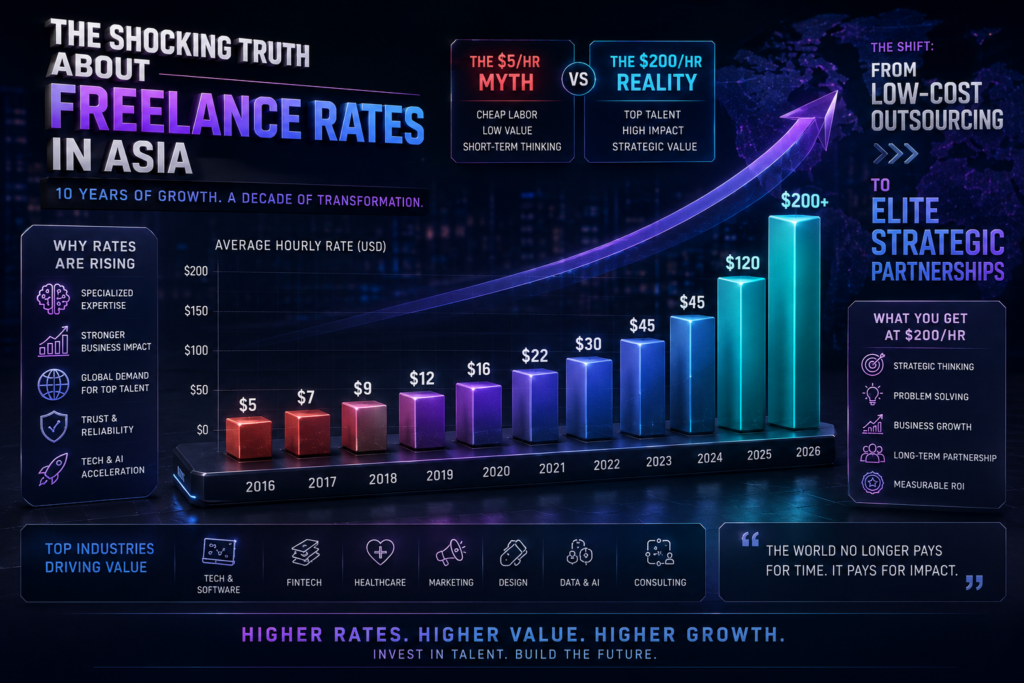
Part III: Why Are Rates Rising So Fast?
Three primary “shocks” to the system have driven these rates to their 2026 peaks:
1. The “Reverse Brain Drain”
For years, Asia’s best talent moved to the US or UK (the “Brain Drain”). In 2026, the trend has reversed. With the rise of high-speed satellite internet and borderless payment systems (Web3 and digital currencies), a top-tier developer in Bali or a strategist in Mumbai can earn a “New York Salary” while enjoying a “Bali Lifestyle.” They no longer need to move to the West to get paid like the West.
2. The Credibility Paradox
In the past, Western companies paid less because they perceived “higher risk” in hiring abroad. Today, Asian freelancers often have better credentials than Western ones. When a freelancer presents a portfolio featuring verified “AI-Assisted Efficiency Gains” for Fortune 500 companies, the geographical discount disappears. The market has moved to Value-Based Pricing.
3. High Demand from Intra-Asian Markets
The “shocking” truth that many Westerners miss is that Asian freelancers are no longer waiting for American clients. The internal Asian market—specifically the growth of tech in Indonesia, Thailand, and Vietnam—is so massive that local companies are competing for their own talent. A freelancer in Jakarta might prefer working for a Singaporean unicorn at $100/hr rather than dealing with a US client who still thinks $30/hr is “generous.”
Part IV: The Regional Price Map (2026 Data)
Understanding the “Shocking Truth” requires a look at the actual numbers across the continent. Rates are no longer uniform; they are hyper-regionalized based on the “Tech Density” of the city.
| City Hub | Primary Specialization | Elite Freelance Rate (Avg) |
| Singapore | Fintech & Fractional C-Suite | $250 – $450/hr |
| Bengaluru (India) | AI, ML & Backend Architecture | $120 – $220/hr |
| Ho Chi Minh (Vietnam) | Low-Code & Automation | $80 – $150/hr |
| Manila (Philippines) | UX/UI & Experience Design | $60 – $110/hr |
| Bangkok (Thailand) | Creative Tech & Digital Asset Mgt | $70 – $130/hr |
Part V: The Quality Shock—You Get What You Pay For
One of the most painful “shocks” for modern businesses is the Quality Gap.
In 2026, if you find a freelancer in Asia charging “old-school” rates (e.g., $15/hr for development), you are almost certainly hiring an AI-shell. These are low-skill individuals who use basic AI to generate subpar work, leading to technical debt, security vulnerabilities, and brand damage.
The “Shocking Truth” is that cheap freelance work in Asia is now more expensive in the long run.
- A “cheap” $20/hr developer might take 100 hours to build a buggy app.
- An “expensive” $120/hr specialist in Bengaluru will use AI-orchestration to build a perfect, scalable app in 10 hours.
The Math: $2,000 for a broken product vs. $1,200 for a perfect one. The “expensive” freelancer is actually the bargain.
Part VI: How to Navigate the New Market
If you are a business owner looking to hire in Asia in 2026, you must change your philosophy. Here is the roadmap to surviving the “Rate Shock”:
1. Abandon the “Hourly” Mentality
Stop asking “What is your hourly rate?” and start asking “What is the price for this outcome?” High-end Asian freelancers prefer Value-Based Retainers. They know their AI tools allow them to work 10x faster; they won’t punish themselves by billing fewer hours for a more valuable result.
2. Verify with “Proof of Human”
In a world of AI-generated portfolios, the most valuable freelancers are those who can walk you through their logic. Use video interviews and live whiteboarding sessions. The shocking truth is that many “freelancers” are now just AI bots in disguise; the real humans are the ones charging $150+/hr.
3. Respect the Time Zone
Asian talent no longer works the “Night Shift” to accommodate Western clocks. If you want top-tier talent in 2026, you must adopt Asynchronous Communication. Respect their 9-to-5, and they will give you the 10x results they are known for.
Part VII: The Future—What Happens Next?
By 2030, the concept of “Offshore” will likely be obsolete. We are moving toward a Single Global Talent Marketplace.
The shocking truth about freelance rates in Asia is that they are the “Canary in the Coal Mine” for the rest of the world. They show us that in an AI-integrated economy, Geogaphy is irrelevant, but Niche Expertise is everything.
Asian freelancers have successfully uncoupled their income from their local cost of living. They have realized that if they provide “Global Quality,” they can demand “Global Rates.”
Conclusion: The New Reality
The era of “hiring from Asia to save a buck” is over. Today, you hire from Asia to save your business.
The shocking truth is that the most expensive freelancers in Asia are often the ones who provide the most profit to their clients. They are no longer “help for hire”; they are strategic partners, architects of the future, and masters of the new AI-driven economy.
If you’re still looking for a $10/hr developer, you’re not just looking in the wrong place—you’re looking in the wrong century. The East has risen, the rates have normalized, and the talent is better than ever. It’s time for the rest of the world to catch up to the “Shocking Truth.”
Key Takeaways for 2026:
- AI has killed the low-end market: Cheap tasks are automated; specialized tasks are premium.
- Reverse Brain Drain is real: Asian talent stays home but bills globally.
- Specialization > Geography: A specialist in Vietnam is worth more than a generalist in London.
- Value-Based Pricing is King: Stop counting hours; start counting results.
Leave your comment