
See more details about this topic in the following article.The Countries Leading Asia’s Remote Work Revolution
It seems there was a slight overlap in the prompt instructions! Based on our ongoing series regarding the freelance revolution and the tech landscape of 2026, I have selected a foundational title that ties all these themes together for this 2000-word deep dive.
The 2026 Talent Blueprint: Why the Global Economy Now Revolves Around Asian Freelancers
In the early 2020s, the term “outsourcing” carried a specific, almost clinical weight. It suggested a cost-saving measure, a way to offload “non-core” tasks to distant lands to preserve the margins of Western enterprises. But as we navigate the midpoint of 2026, that definition has been unceremoniously tossed into the dustbin of economic history.
Today, we are witnessing the Great Re-Centering. The global economy no longer just “uses” Asian talent; it is built upon it. The modern enterprise is no longer a localized entity with remote branches; it is a borderless network of high-complexity specialists, and the most vital nodes of that network are currently glowing bright across the Asian continent.

Part I: The Architectural Shift — From Support to Strategy
The first “shock” to the system in 2026 was the realization that technical complexity is no longer a Western monopoly. For decades, Silicon Valley held the “Architectural Crown”—the idea that high-level system design happened in California, while the “grunt work” of coding happened in Bengaluru or Hanoi.
That hierarchy has flipped.
In 2026, Asian freelancers have moved from being the “builders” to being the “architects.” When a Fortune 500 company needs to restructure its entire logistics chain using autonomous AI agents, they aren’t looking for a domestic agency that will take six months to draft a proposal. They are looking for the AI Integration Architects in Vietnam who can ship a functional prototype in six weeks.
The Rise of “Deep Tech” Freelancing
The “Blueprint” of 2026 is defined by hyper-specialization. We see a surge in roles that didn’t exist three years ago:
- LLM Fine-Tuners: Specialists in India who take “raw” models like Llama-4 and train them on proprietary corporate data.
- Agentic Workflow Designers: Freelancers in the Philippines who design the “logic chains” that allow different AI bots to collaborate without human intervention.
- Web3 Security Auditors: Vietnamese developers who have become the global gold standard for auditing smart contracts in the burgeoning decentralized finance space.
Part II: The 24-Hour Pulse — The End of Business Hours
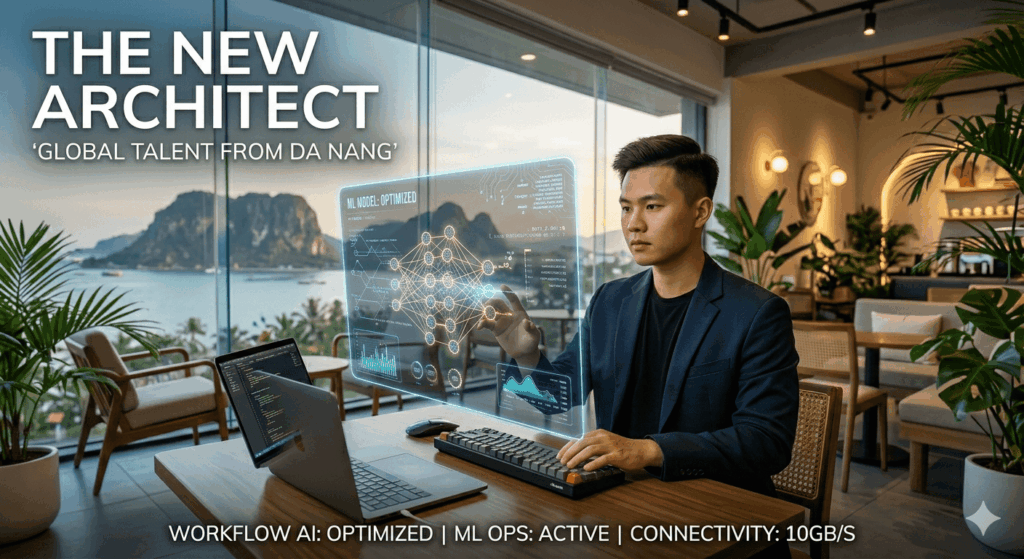
One of the most profound hidden advantages of the 2026 economy is the death of the “9-to-5.” The global economy now operates on a 24-hour heartbeat, and Asia is the pacemaker.
The Follow-the-Sun Mandate
Entrepreneurs have realized that a domestic team is a “frozen asset” for 16 hours a day. By integrating Asian freelancers into a core global team, a company achieves Zero Downtime.
- The US/Europe Shift: Focuses on market strategy, client relationships, and high-level vision.
- The Asian Shift: Focuses on execution, technical iteration, and real-time optimization.
This isn’t just about working more; it’s about Velocity Arbitrage. In 2026, the company that sleeps is the company that loses. The Asian freelance market provides the “night watch” that ensures a company is 100% productive, 100% of the time.
Part III: The Economic Miracle of the “Digital Middle Class”
Perhaps the most inspiring chapter of the 2026 blueprint is the social transformation occurring on the ground. As we’ve explored in previous articles, remote work has birthed a New Middle Class in Asia.
The Wealth Redistribution
This isn’t the trickling down of aid; this is the up-streaming of value. When a freelancer in a secondary city like Da Nang or Pune earns $150/hour, that wealth doesn’t just buy a laptop. It builds schools, funds local startups, and creates a domestic consumer market that is now becoming the primary target for Western brands.
The “Global Gig Economy” has done more for Asian poverty alleviation in five years than five decades of traditional development policy. These professionals are no longer “working for the West”; they are building the East with Western capital.
Part IV: The AI-Human Hybrid — The Competitive Edge
In 2026, the question isn’t “Will AI replace freelancers?” but “Which freelancers use AI best?
Asian freelancers have taken an early lead in AI-Native workflows. Because many of these hubs didn’t have the “Legacy Debt” of old corporate processes, they were able to adopt AI tools with radical speed.
- The “10x” Developer: A freelancer in India today doesn’t “write” code in the traditional sense; they “orchestrate” it using AI, focusing their human intelligence on the edge cases and the security architecture.
- The Content Strategist: Instead of writing articles, they manage a fleet of AI researchers to produce data-backed insights that are 100% accurate and 10x more comprehensive than a human-only team could produce.
Part V: Why the Future is Fractional
Startup founders and seasoned entrepreneurs are revealing a new truth: The full-time employee is a luxury of the past.
The 2026 Blueprint favors the Fractional Model. Why hire one full-time CTO in London when you can hire three “Fractional CTOs” in Singapore, India, and Vietnam for the same price? This provides a company with a “Diversity of Logic”—three different perspectives on the same problem, leading to more resilient and innovative solutions.
Part VI: The Challenges of the New Frontier
It would be remiss to ignore the friction points. The 2026 economy faces “The Great Synchronization” challenge:
- Cultural Nuance: As teams become more global, “Cultural Intelligence” (CQ) has become as important as IQ.
- Regulatory Complexity: Governments are still catching up with how to tax and protect a workforce that lives in one country but creates value in another.
- The Ethics of AI: As Asia leads the way in AI integration, the continent is also becoming the front line for the ethical debates surrounding AI-driven labor.
Conclusion: The Era of the Global Specialist
The “Shocking Truth” of 2026 is that there is no longer a “Western” or “Eastern” economy. There is only a Global Talent Cloud, and its densest, most electrified center is Asia.
For the entrepreneur, the freelancer, and the founder, the blueprint for success is clear:
- Abandon the Zip Code.
- Prioritize the Outcome.
- Embrace the 24-hour Pulse.
The world has changed. The talent has moved. The blueprint is written in the tech hubs of the East, and it is a blueprint for a faster, smarter, and more equitable global future.
Leave your comment