

See more details about this topic in the following article.
Why the Global Gig Economy Depends on Asia
In 2026, the global economy is no longer a collection of isolated national markets; it is a hyper-connected, real-time ecosystem of task-based labor. At the center of this transformation is Asia. While Western headlines often focus on Silicon Valley’s latest AI models or European labor regulations, the “engine room” that keeps the global gig economy running is located in the tech hubs of India, the automation labs of Vietnam, and the remote work clusters of the Philippines.
The “Shocking Truth” of 2026 is that the global gig economy doesn’t just benefit from Asia—it is fundamentally dependent on it. Without the specialized talent, digital infrastructure, and rapid upskilling occurring across the Asian continent, the digital transformation of Western enterprises would grind to a halt.
Part I: The Demographic Powerhouse
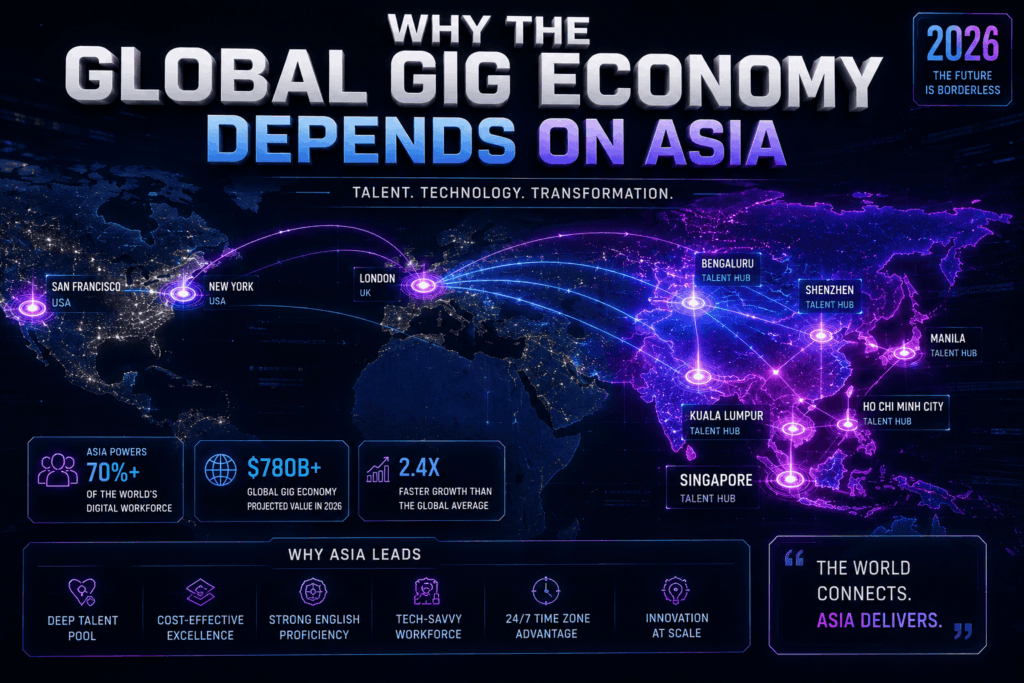
The most basic reason for this dependence is sheer scale. By 2026, the Asia-Pacific region accounts for more than 63 million active gig economy contributors. India alone has solidified its position as the world’s largest digital freelancing ecosystem, contributing a massive share of the global remote workforce.
1. The STEM Graduation Gap
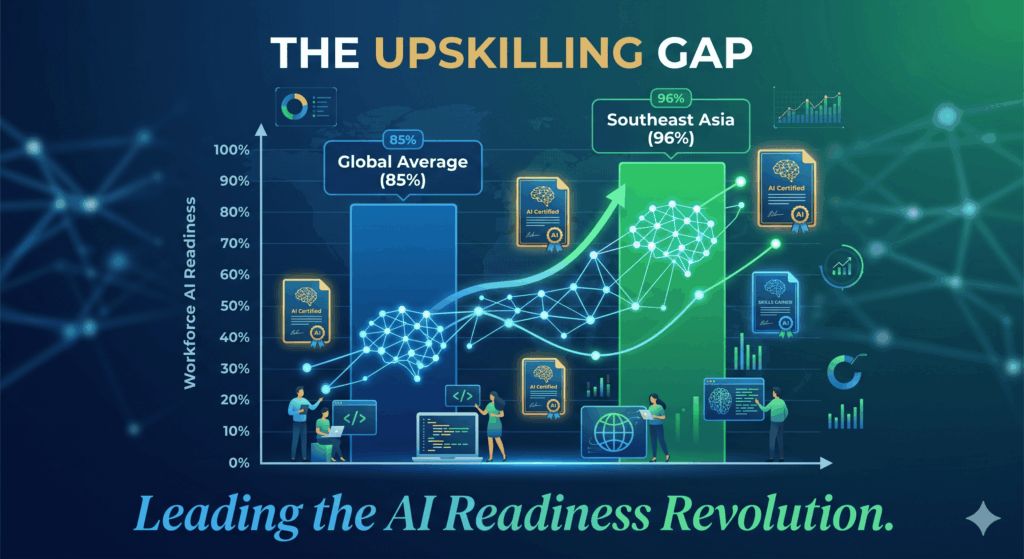
While the U.S. and Europe struggle with a shortage of technical graduates, Asia is producing STEM (Science, Technology, Engineering, and Mathematics) talent at an unprecedented rate. In 2026, Southeast Asian employers are outpacing their global peers in addressing skills gaps: 96% of employers in the region are prioritizing upskilling, compared to a global average of 85%. This massive pipeline of talent ensures that when a global company needs 500 AI integration specialists or 200 cybersecurity consultants, they find them in Asia.
2. The Youth Advantage
With over 62% of the global gig workforce now composed of Millennials and Gen Z, Asia’s young, tech-native population has a natural advantage. Unlike older workforces in the West, these digital natives have grown up in a “mobile-first” and “AI-first” world. They don’t just use digital tools; they optimize them.
Part II: The AI Integration Engine
In 2026, the “Global Gig Economy” is essentially the “AI Economy.” Every major corporation is currently racing to integrate Large Language Models (LLMs) and automated workflows into their operations. However, most companies lack the in-house talent to do this.
Asia has become the world’s AI Integration Engine.
1. The 80/20 Rule of AI Revenue
A significant trend in 2026 is that 80% of freelance revenue comes from AI Integration work—connecting APIs like GPT-4 or Claude into existing business systems. Only 20% comes from building new models. Asian freelancers have mastered this 80%. They are the “plumbers” of the AI age, ensuring that the data flows correctly between a company’s CRM and its AI customer service bot.
2. Data Labeling and Training
The “Hidden Labor” of AI—the massive task of labeling data to train models—is almost entirely concentrated in Asia. In 2026, this sector has grown by +154%, and it is the backbone of every AI model used in the West. Without the millions of gig workers in the Philippines, Indonesia, and India refining these models, AI would remain a theoretical curiosity rather than a functional business tool.
Part III: Digital Infrastructure as a Competitive Edge
The dependence on Asia is also driven by the region’s aggressive investment in digital infrastructure. By 2026, Asia-Pacific leads the regional market in freelance platform revenue, projected to hit $8.3 billion by 2033 with a staggering growth rate of 21.4%.
1. The “Mobile-First” Revolution
In many parts of Southeast Asia, the “PC era” was skipped entirely. Workers went straight to high-speed 5G smartphones. This has created a workforce that is incredibly agile. A freelancer in Thailand can manage a global marketing campaign entirely from a mobile-optimized AI dashboard, providing a level of responsiveness that traditional “office-based” workers in the West cannot match.
2. Fintech and Seamless Payments
The rise of digital wallets and unified payment systems (like India’s UPI) has solved the “payment friction” that used to plague international freelancing. In 2026, a company in London can pay a developer in Vietnam in seconds with near-zero transaction fees. This financial inclusion has brought millions of new, high-skilled workers into the global marketplace.
Part IV: The Quality Shift—From “Cheap” to “Elite”
Perhaps the most significant reason for the global dependence on Asia is the Quality Shift. The old myth of “hiring from Asia to save money” is dead. In 2026, you hire from Asia to get the best results.
1. The Rise of the Super-Specialist
Asian freelancers are no longer generalists. They are hyper-specialists. You don’t just hire a “developer” in Bengaluru; you hire a “Senior MLOps Engineer specialized in Fraud Detection for Fintech.” These specialists command rates of $120–$250/hour, out-earning many mid-level engineers in Silicon Valley.
2. Velocity Culture
In the West, projects often get bogged down in corporate bureaucracy. In the Asian gig economy, the culture is one of Velocity. Because these freelancers operate in a highly competitive, results-oriented marketplace, they ship code and deliver strategies at a pace that Western internal teams often find “shocking.”
Part V: The Strategic Pivot for Western Firms
By 2026, any global firm that does not have an “Asia-First” freelance strategy is at a severe disadvantage. The gig economy has moved from being a way to handle “overflow work” to being the primary driver of innovation.
1. Fractional Leadership from the East
We are seeing a surge in Fractional CTOs and CFOs based in Singapore and Hong Kong. These elite freelancers provide high-level strategic guidance to startups in Europe and the US, bringing a unique “Global South” perspective that is essential for companies looking to scale into emerging markets.
2. The 24/7 Productivity Cycle
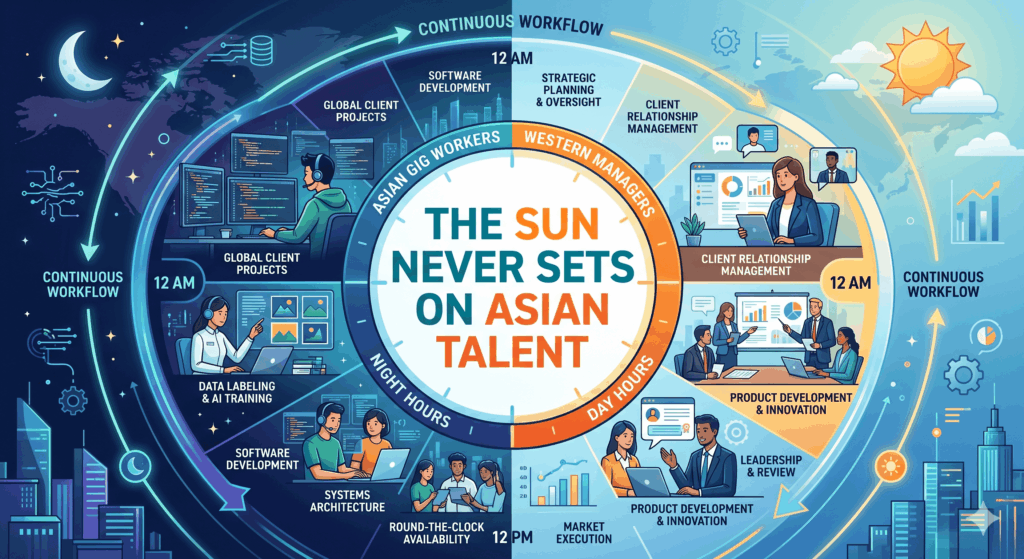
The time-zone difference between the West and Asia is no longer a hurdle; it’s a feature. Western firms use Asian freelancers to achieve a 24-hour development cycle. Work defined in San Francisco at 5 PM is completed in Ho Chi Minh City by 9 AM the next day. This “follow-the-sun” model is the only way to stay competitive in the high-speed market of 2026.
Conclusion: A Symbiotic Future
The global gig economy is no longer a one-way street. It is a symbiotic relationship where the West provides the capital and the high-level demand, and Asia provides the technical soul and execution power.
In 2026, the shocking truth is clear: if you unplugged Asia from the global digital workforce, the “Cloud” would evaporate, AI would stop learning, and the digital transformation of the last decade would collapse. The world doesn’t just use Asian freelancers; it depends on them.
Key Data Points for 2026:
- Asia-Pacific Freelance Market: Projected to reach $8.3 Billion (21.4% CAGR).
- AI/ML Freelancer Demand: +1,847% increase since 2023.
- Top Earning Region: India and Singapore (Rates up to $400/hr for strategic roles).
- Upskilling Priority: 96% of Southeast Asian employers (vs. 85% globally).
Leave your comment