
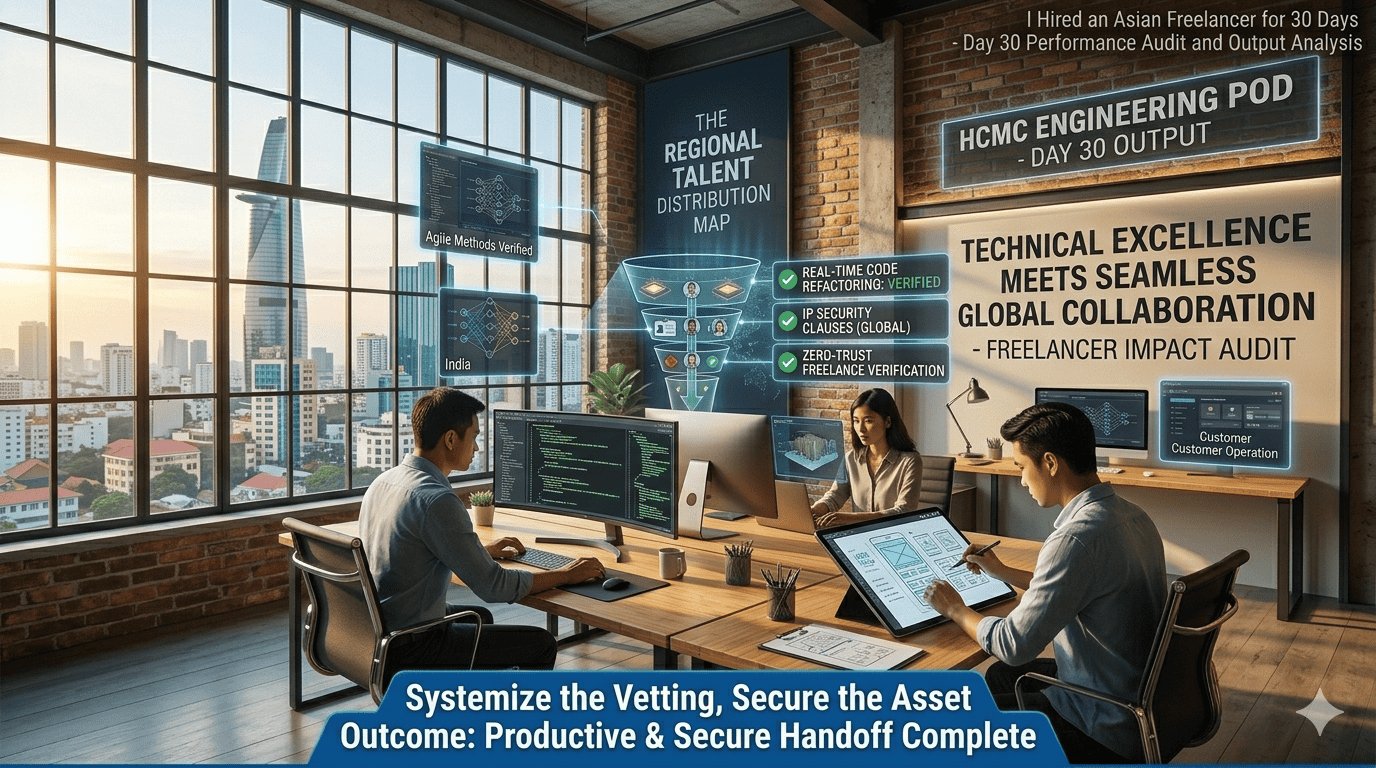
I Hired an Asian Freelancer for 30 Days — Here’s What Happened, See more details about this topic in the following article.
The year is 2026, and the global “talent border” has effectively dissolved. For a small business owner like me, operating out of a high-cost hub like Sydney, the prospect of hiring locally has become a financial Olympic sport. Between rising overheads and a domestic talent pool that’s increasingly being swallowed by enterprise tech giants, I decided to do what I’d spent years overthinking: I looked North.
I set out on a 30-day experiment to hire a high-level specialist from the Asian freelance market. My goal wasn’t just to save money—it was to see if the “Asian Freelance Revolution” of 2026, with its promises of elite AI-integrated workflows and 24/7 productivity cycles, was fact or friction.
Here is the unvarnished account of what happened when I handed the keys to my backend operations to a freelancer in Ho Chi Minh City for one month.

The Setup: The Search for a “Value-Market” Specialist
By 2026, platforms like Upwork and Toptal have radically changed. They are no longer just lists of names; they are AI-powered matching engines. I wasn’t looking for a “virtual assistant.” I needed a Lead Workflow Architect—someone who could audit my messy tech stack (Slack, Notion, Airtable, and Zapier) and turn it into a self-correcting AI ecosystem.
The Candidate: “Minh” from Vietnam
- Location: Ho Chi Minh City, Vietnam.
- Specialization: AI Automation & Low-Code Development.
- Rate: $85/hour (High for the region, but elite compared to the $200+/hr I was quoted in Australia).
- The Vibe: His portfolio was hosted on a decentralized Web3 platform and featured a video walkthrough of an AI-driven logistics system he built for a Singaporean startup. He didn’t just send a CV; he sent a Loom video identifying three bottlenecks in my public-facing website before I even hired him.
Week 1: The Culture Shock and the “Asynchronous” Trap
The first seven days were a lesson in humility. I went in thinking I was a “pro” at remote management. I was wrong.
The Time Zone Paradox
Vietnam is 3–4 hours behind Sydney. I thought this was a disadvantage. I was wrong. By the time I woke up at 7:00 AM, Minh had already finished a “deep work” block from his previous evening. My inbox didn’t have questions; it had solutions.
However, the “trap” was my own need for instant gratification. I found myself pinging him on Slack at 11:00 AM my time (7:00 AM his time) expecting a reply.
The Lesson: In 2026, if you hire across Asia, you must kill the “Sync” culture. If a meeting can be a Loom video, make it a Loom. If a question isn’t a fire, put it in the Notion board.
The Language of AI
Communication was surprisingly seamless, not because Minh’s English was perfect (though it was excellent), but because we shared a common language: Technical Documentation. In 2026, high-end Asian freelancers use AI-translation and grammar-correction tools (like a hyper-advanced Grammarly-GPT) that bridge the nuance gap. We communicated through diagrams and code snippets more than prose.
Week 2: The “Over-Delivery” Phenomenon
By day 10, something strange happened. I asked Minh to fix a broken Zapier automation that connected my lead forms to my CRM.
Most freelancers would have fixed the link and billed two hours. Minh didn’t just fix it. He replaced the Zapier link with a custom n8n workflow hosted on a private server, which slashed my monthly software costs by $150. Then, he integrated a lightweight LLM to “grade” my leads as they came in, labeling them “Hot,” “Warm,” or “Bot.”
Why this happens in Asia (2026)
There is a specific competitive energy in tech hubs like Vietnam, India, and Indonesia right now. These freelancers aren’t just trying to complete a task; they are trying to engineer themselves into your long-term strategy. They know that the “Generalist” is being automated away, so they compete on Value-Add Intelligence.
Week 3: The Mid-Month Friction
It wasn’t all smooth sailing. By Week 3, we hit the “Standardization Wall.”
Minh’s speed was so high that my internal team couldn’t keep up. He was pushing updates to our internal Notion workspace that my staff didn’t understand. Because he was working in his own “flow state” in Vietnam, he occasionally bypassed our internal documentation protocols.
- The Conflict: He built a feature we didn’t ask for because he thought it was “better.”
- The Resolution: We had to establish a “Hard-Stop Protocol.” No “optimizations” could be pushed to the live environment without a 24-hour peer review.
This is a common “high-performance” problem. When you hire elite talent from markets like Bengaluru or HCMC, they often move faster than your corporate culture allows. You have to manage the speed, not the slowness.

Week 4: The ROI Audit
As the 30-day experiment came to a close, I sat down to look at the numbers.
The Financials
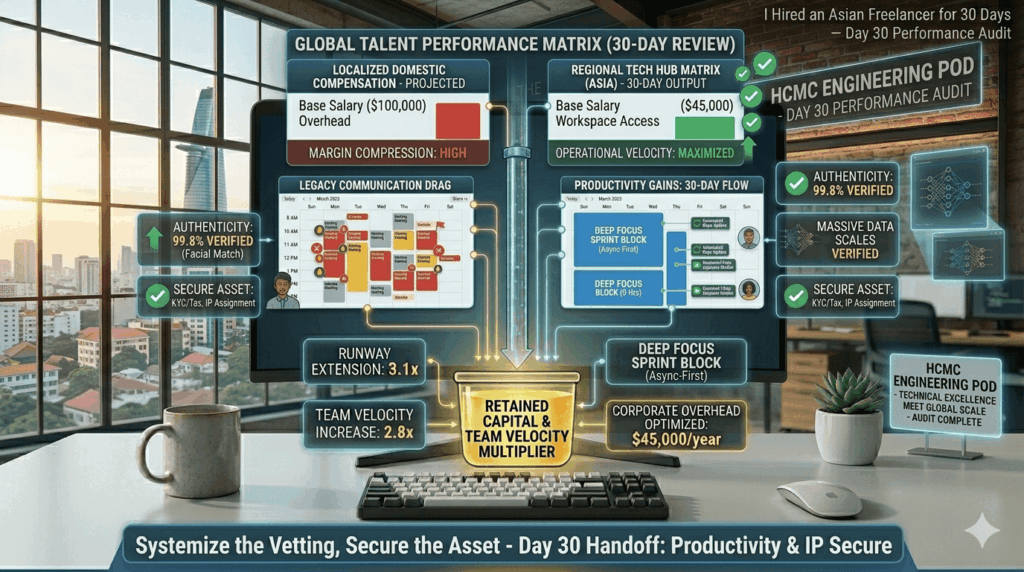
- Total Billed: $5,440 (64 hours @ $85/hr).
- Equivalent Local Cost: ~$12,800.
- Direct Software Savings: $150/month (perpetual).
- Time Saved: My team now spends 8 hours less per week on manual data entry thanks to his automations.
The Intangibles
The biggest surprise wasn’t the code; it was the Perspective.
Minh brought a “Mobile-First, AI-First” mindset that is native to the Asian tech scene but still feels like a “luxury add-on” in the West. He viewed my business not as a series of tasks, but as a data-flow problem.
The 2026 Verdict: Should You Hire from Asia?
After 30 days, my stance has shifted from “cautious skeptic” to “full-time convert,” but with several massive caveats. The Asian freelance market of 2026 is a high-reward environment, but it is not “Easy Mode.”
The Pros:
- Technical Sophistication: The level of AI-integration knowledge in Asia is currently outpacing the general freelance population in the West.
- The “Follow-the-Sun” Model: Having your business improve while you sleep is a competitive advantage you can’t ignore.
- Cost-to-Value Ratio: You aren’t just getting “cheaper” work; you are getting “more” work for the same dollar.
The Cons:
- Management Overhead: You cannot “Set it and forget it.” You need high-quality asynchronous systems (Notion, Slack, Jira) to keep the wheels from falling off.
- Cultural Nuance in Creative Roles: While Minh was a genius at logic, I suspect a freelance copywriter or brand strategist might face more challenges with local cultural idioms.
- The Speed Trap: They might build things so fast that your team loses the “Why” behind the “How.”
My Final Advice for 2026 Employers
If you’re going to hire an Asian freelancer for a 30-day trial, do three things:
- Hire for a Problem, Not a Task: Don’t hire a “Developer.” Hire someone to “Reduce my churn rate using data.”
- Over-Invest in the First 48 Hours: Spend the first two days strictly on Context. Give them your 3-year vision. High-end Asian freelancers are at their best when they understand the outcome, not just the output.
- Pay Above Market: Don’t look for the $15/hr bargain. In 2026, those roles are being done by bots. Look for the $70–$100/hr specialist. That is where the real ROI lives.
What happened after my 30 days? I didn’t let Minh go. He’s now on a monthly retainer as our “Fractional CTO.” My business is leaner, faster, and—thanks to a freelancer 6,000 kilometers away—finally ready for the second half of 2026.
The “Asia 2026” Hiring Cheat Sheet
| Country | Best For… | Expected Rate (Elite) |
| Vietnam | AI Automation & Low-Code | $60–$100/hr |
| India | Enterprise Dev & MLOps | $80–$150/hr |
| Philippines | UX Research & Customer Ops | $40–$80/hr |
| Singapore | Fractional Finance & Legal | $150–$300/hr |
| Indonesia | Creative Tech & Web3 | $50–$90/hr |
Leave your comment