
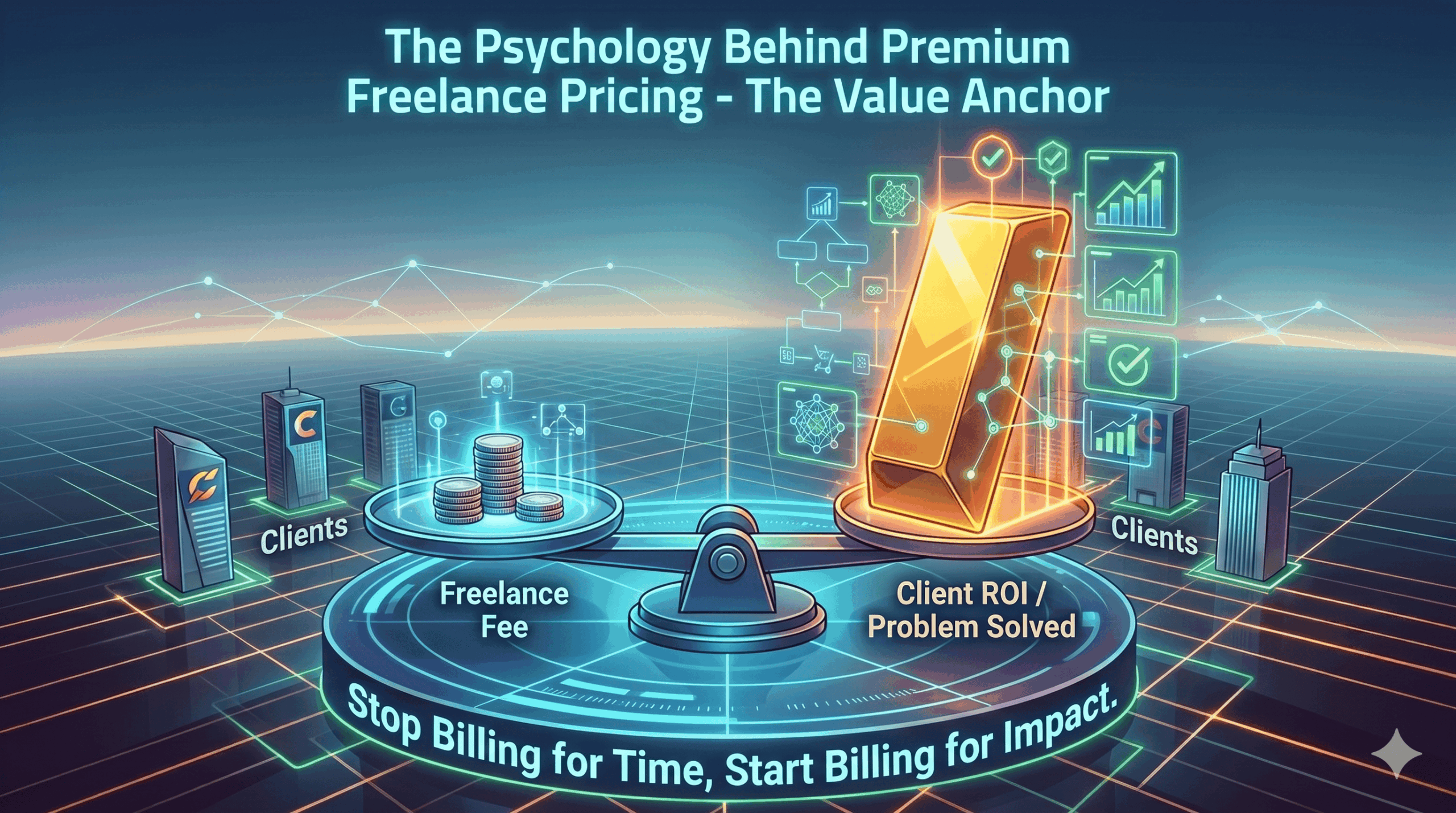
See more details in this article about,The Psychology Behind Premium Freelance Pricing
The Psychology Behind Premium Freelance Pricing: Why Clients Pay $200/hr When Others Charge $20
In the hyper-competitive freelance landscape of 2026, a glaring paradox has emerged. While AI tools and global platforms have theoretically driven the “cost of production” for digital services toward zero, a select tier of elite freelancers is seeing their rates skyrocket. In tech hubs across Asia and the West, we are seeing “Specialist Architects” command $250 per hour for work that a generalist might offer for $25.
Why does a CEO in New York or a Startup Founder in Singapore willingly pay a 1,000% premium for essentially the same “output?
The answer lies in Psychology. Premium pricing is not a mathematical calculation of hours spent; it is a sophisticated exercise in risk mitigation, authority signaling, and value perception. To command elite rates, you must stop selling your labor and start selling the psychological relief of a solved problem.
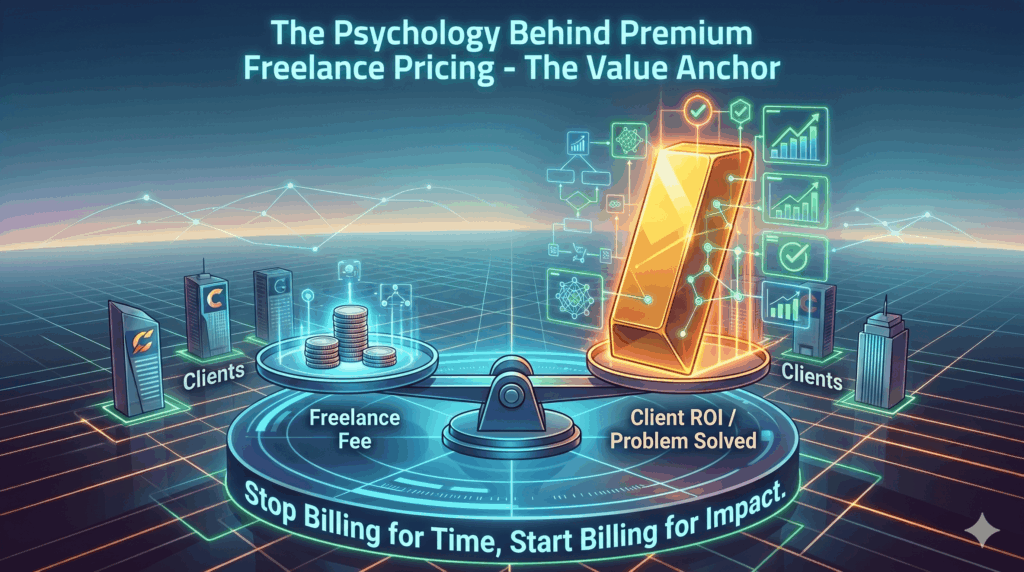
Part I: The Risk-Mitigation Framework (The Fear of the Cheap)
The most powerful psychological driver behind premium pricing is Loss Aversion. In behavioral economics, the pain of losing is twice as powerful as the joy of gaining. For a business owner, hiring a “cheap” freelancer is not a bargain; it is a high-stakes gamble.
1. The Cost of Failure vs. The Cost of Service
When a client hires a freelancer to build an AI-integrated sales funnel, they aren’t just paying for code. They are protecting their projected revenue. If the $20/hr freelancer fails, the client hasn’t just lost $20; they have lost the $50,000 in revenue that the funnel was supposed to generate, plus the two months of wasted time.
- The Premium Pivot: High-ticket freelancers position their price as an “Insurance Policy.” By charging $5,000 instead of $500, they signal that they have the competence to ensure the $50,000 outcome is realized.
2. Price as a Proxy for Quality
The “Chivas Regal Effect” is a psychological phenomenon where consumers assume a product is of higher quality simply because it is more expensive. In freelancing, a low price often triggers a “Red Flag” in a premium client’s mind: “If they were actually good, why would they be so cheap?” Premium pricing removes the suspicion of incompetence.
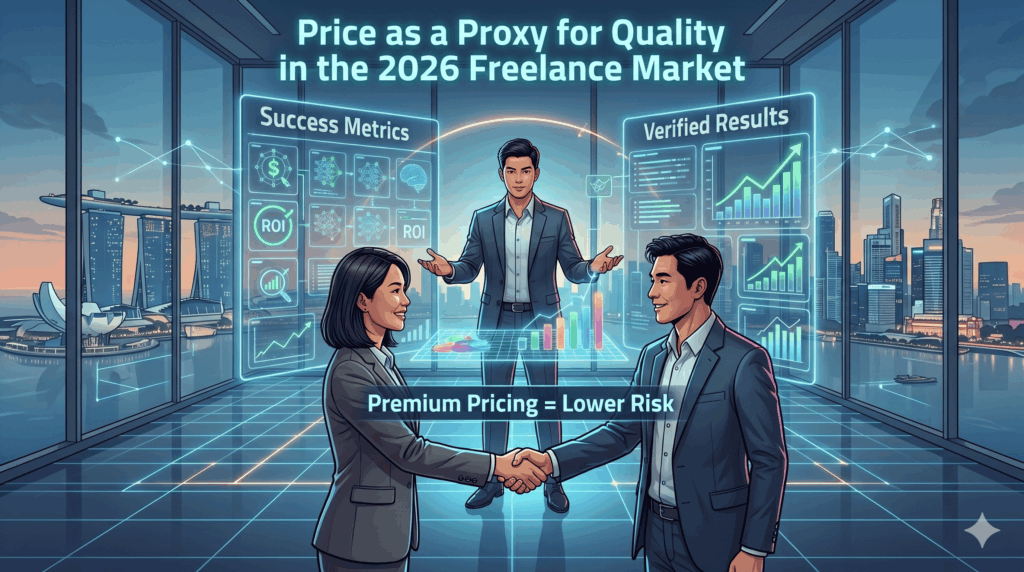
Part II: The Authority Signal (The Expert vs. The Commodity)
In 2026, the “Generalist” is a commodity. If you describe yourself as a “Web Developer,” you are psychologically categorized alongside millions of others—and AI. Premium pricing requires Categorical Dominance.
1. The Power of “The Niche of One”
Psychologically, we value specialists more than generalists. We pay a general practitioner $50 for a checkup, but we pay a neurosurgeon $5,000 for a procedure.
- The Strategy: Top freelancers in Asia and the West build their brand around a “Micro-Niche.” They aren’t “Copywriters”; they are “Conversion Architects for Series B SaaS Companies.” By narrowing the niche, they become the only logical choice, allowing them to dictate the price.
2. The “Human-in-the-Loop” Premium
As AI-generated content floods the market, there is a psychological “Flight to Quality.” Clients are now paying a premium for Discernment. The elite freelancer’s price reflects their ability to audit, refine, and strategically direct AI tools—a human “Seal of Approval” that carries immense psychological weight in an automated world.
Part III: Value-Based Anchor Bias (The $0 to $1,000,000 Bridge)
Premium pricing is almost never absolute; it is relative. The psychological concept of Anchoring dictates that the first number a client hears sets the stage for all following negotiations.
1. Shifting the Anchor from “Labor” to “ROI”
If you anchor your price to “hours worked,” the client’s brain compares your rate to a minimum wage or a standard salary. You lose.
- The Elite Move: Anchor the price to the Size of the Problem. If you are solving a $1,000,000 churn problem, a $20,000 project fee feels like a 98% discount. Psychologically, the client is no longer “spending” money; they are “investing” in a massive return.
2. The “Price-Less” Discovery
Top freelancers use “Discovery Sessions” to uncover the deep-seated psychological pain points of the founder. Once the pain is articulated—sleepless nights, stalled growth, investor pressure—the price of the solution becomes secondary to the relief of the resolution.
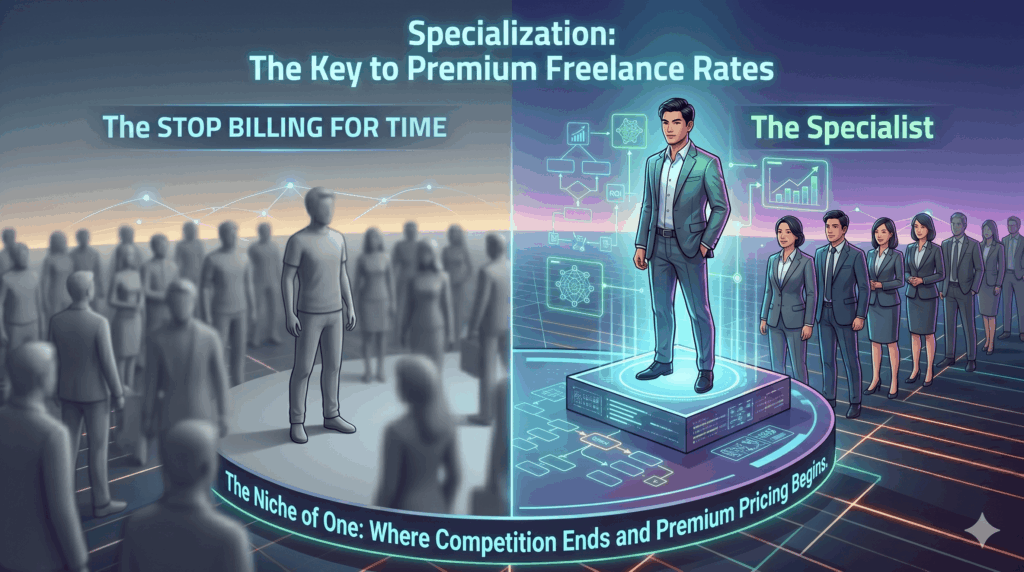
Part IV: The Social Proof and “Scarcity” Trigger
The psychology of Social Proof and Scarcity creates a “Fear of Missing Out” (FOMO) that justifies premium rates.
1. The Waitlist as a Pricing Lever
A freelancer who is “available to start tomorrow” signals low demand (and therefore, lower value). A freelancer with a “3-week onboarding backlog” psychologically signals that they are a proven winner. This scarcity allows them to raise rates without losing clients—in fact, it often attracts better clients who want the “best in class” talent that everyone else is waiting for.
Part V: Conclusion—The Price is the Product
The “Shocking Truth” of the 2026 freelance economy is that your price is part of your branding.
Low rates attract “Nightmare Clients” who micromanage and devalue your work. Premium rates attract “Partners” who respect your expertise and stay out of your way so you can deliver results.
Premium pricing is a psychological boundary. It tells the world: “I am not a pair of hands for hire; I am a strategic asset that delivers predictable outcomes.” When you master the psychology of pricing, you stop competing on cost and start competing on Value, Authority, and Trust.
Leave your comment