
Read this article to learn more about this topic,12 Productivity Hacks Used by Top Freelancers in Asia
12 Productivity Hacks Used by Top Freelancers in Asia
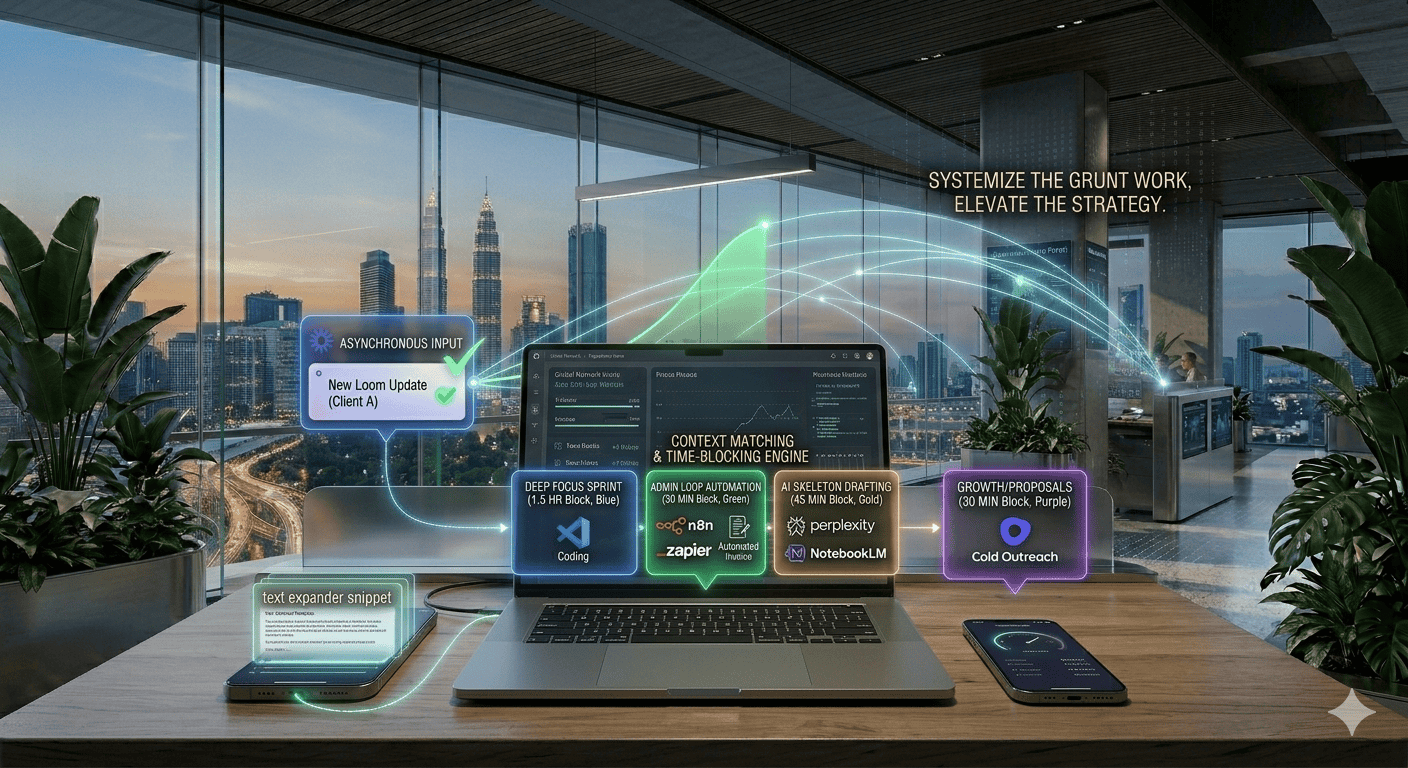
The independent workforce in Asia has hit a critical inflection point. The regional freelance economy has shifted away from simply undercutting Western labor costs; instead, it is driven by Extreme System Efficiency.
As automated AI utilities commoditize basic generation, the top 1% of independent consultants, developers, and data architects across hubs like Singapore, Bengaluru, and Da Nang are scaling their revenue by out-optimizing the market. They don’t work more hours; they use an airtight structural framework to get 10x more done in less time.
If your goal is to break free from continuous burnout and build a highly scalable independent operation, these are the 12 productivity hacks used by Asia’s elite freelancers.
Part I: Cognitive Architecture & Time Defense
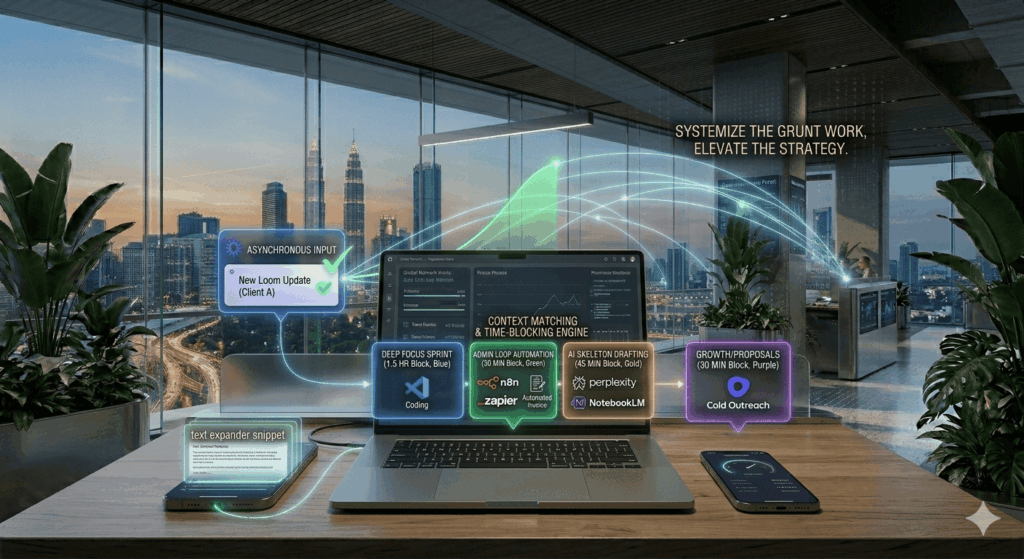
1. The “Asynchronous First” Communication Gateway
Top earners completely protect their mornings from live meetings. They understand that jumping on a “quick 15-minute alignment call” at the whim of a client breaks their deep-work flow state.
- The Hack: Move 90% of communication to asynchronous loops. Use tools like Loom or Notion to record 2-minute project breakdowns during your afternoon. Send them over so your global clients open them during their morning, removing the need for real-time meetings.
2. Time-Blocking via “Context Matching”
Instead of jumping between writing an invoice, checking email, and writing code, elite freelancers block out distinct days or halves of days for specific mental states.
- The Hack: Divide your week into Deep Work Blocks (pure production, zero notifications), Admin Blocks (invoicing, updating CRM databases), and Growth Blocks (sending outbound cold proposals, publishing thought leadership on LinkedIn).
3. The 90-Minute Energy Cycle Sprint
Abandon the rigid 8-hour workday. Human focus operates on ultradian rhythms—biological waves of high focus followed by energy drops.
- The Hack: Work in intense, distraction-free 90-minute sprints, followed by a hard 20-minute disconnect (no screens, walking away from the desk). This prevents late-afternoon brain fog and sustains high output.
Part II: The Autonomous Tech & AI Layer
4. Custom “Text Expander” Snippets
If you type out the same introductory email, onboarding instructions, or contract clauses more than three times a week, you are bleeding time.
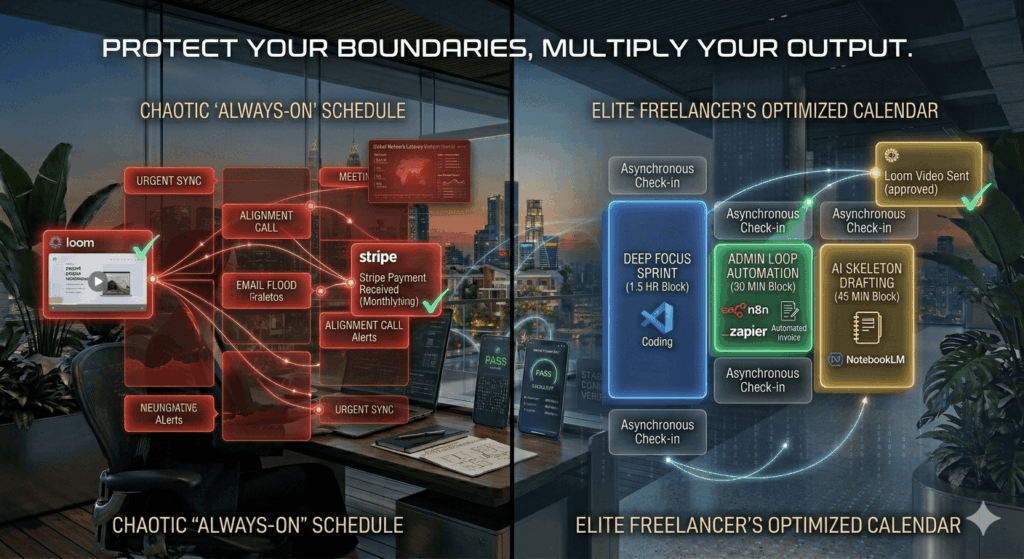
- The Hack: Use a desktop text expander (like Slashit or TextExpander). Setting up a short macro keyboard shortcut like
/kickoffinstantly populates a beautifully formatted, structured message with placeholders, saving hours of manual drafting.
5. AI-Assisted “Skeleton Drafting”
Elite freelancers don’t stare at blank screens. They use advanced conversational AI models as a co-pilot to kill initial execution friction.
- The Hack: Use AI to generate the underlying architectural skeleton, documentation outlines, or structural coding logic of a project. Once the structure is built, step in as the high-level human director to edit, refine, and infuse your unique professional insight.
6. Source-First Data Extraction Engines
Manual data entry or scraping information from 100-page client PDF briefs is a low-value task that should be completely automated.
- The Hack: Deploy source-first tools like NotebookLM or Perplexity. Feed them messy data, client records, or long regulatory updates, and instantly use specific queries to pull structured tables, saving days of manual document cross-referencing.
Part III: Administrative & Operational Mastery
7. Productizing the Onboarding Funnel
Writing a custom 5-page proposal and contract for every $1,000 project is an operational bottleneck.
- The Hack: Standardize your core services into fixed, predictable product packages (Productized Services). Use all-in-one operations tools (like Taskip or FloworkOS) to automatically trigger the proposal, legal agreement, and initial Stripe deposit payment in a single, one-click automated flow.
8. System-Level Micro-Automations
The most productive freelancers don’t copy and paste data between apps. They build automated digital bridges to let software do the heavy lifting.
- The Hack: Use automation platforms like n8n or Zapier to create simple task loops. For example: When a client marks a task as “Approved” in Trello, automatically generate a FreshBooks invoice and send it via email.
9. Upstream “Buffer Time” Scheduling
Back-to-back client calls leave zero room for actual production, leading directly to working late nights.
- The Hack: When using scheduling tools like Calendly or Doodle, configure strict internal rules: minimum 30-minute buffers between slots, maximum of 3 calls per day, and a automatic 24-hour advance notice requirement for all bookings.
Part IV: Environmental & Mental Shielding
10. The Dual-Profile Digital Boundary
Mixing personal browsing tabs with client project windows leads to massive cognitive distraction.
- The Hack: Separate your life into two distinct digital environments. Use completely separate browser profiles (or dedicated workspace managers) with independent bookmarks, extension toolsets, and logins. When the work profile is closed, the business is completely off.
11. “Leak-Proof” Precision Auditing
To charge top-tier value-based rates, you must have total clarity on where your operational time is actually going.
- The Hack: Use an automatic time-tracker like Toggl Track. Log your billable and non-billable time down to the exact minute. Review these metrics weekly to identify which low-value administrative tasks need to be automated or outsourced to a junior assistant.
12. Establishing the Financial “Fortress” Fund
Freelancers often accept low-paying, nightmare projects out of immediate survival panic, destroying their daily productivity and focus.
- The Hack: Build a 6-month cash reserve that covers your personal overhead and business costs. When you aren’t desperate for quick cash, your psychological baseline stabilizes, giving you the power to say no to bad clients and focus entirely on high-value execution.
Conclusion: Build Repeatable Systems
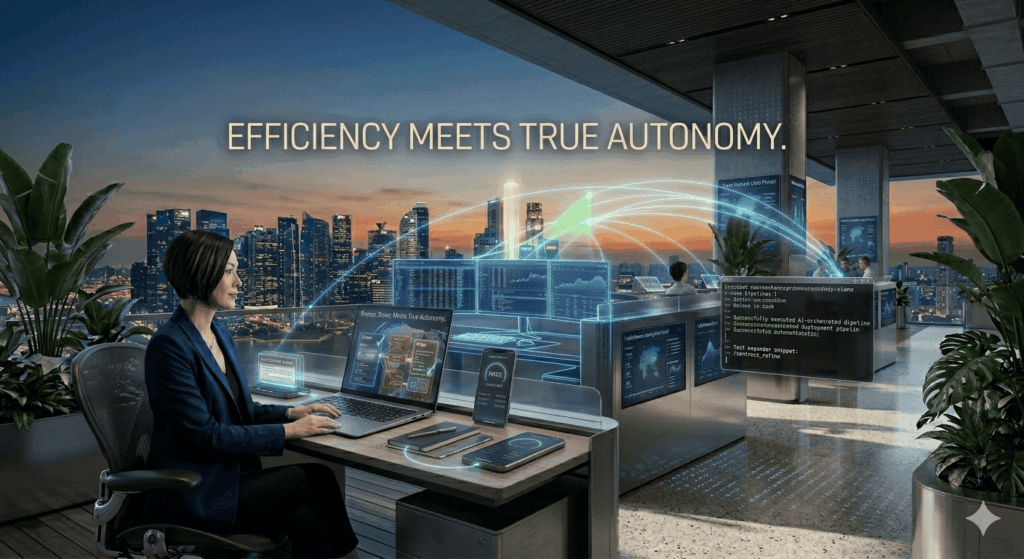
Productivity in the modern freelance economy is not about raw hustle or working until your eyes blur; it is a design problem.
By moving to asynchronous communication, automating your administrative loops, and leveraging AI for initial project structures, you turn your skills into a predictable system. Take the pressure off your willpower and let your operational infrastructure do the heavy lifting.
Leave your comment