
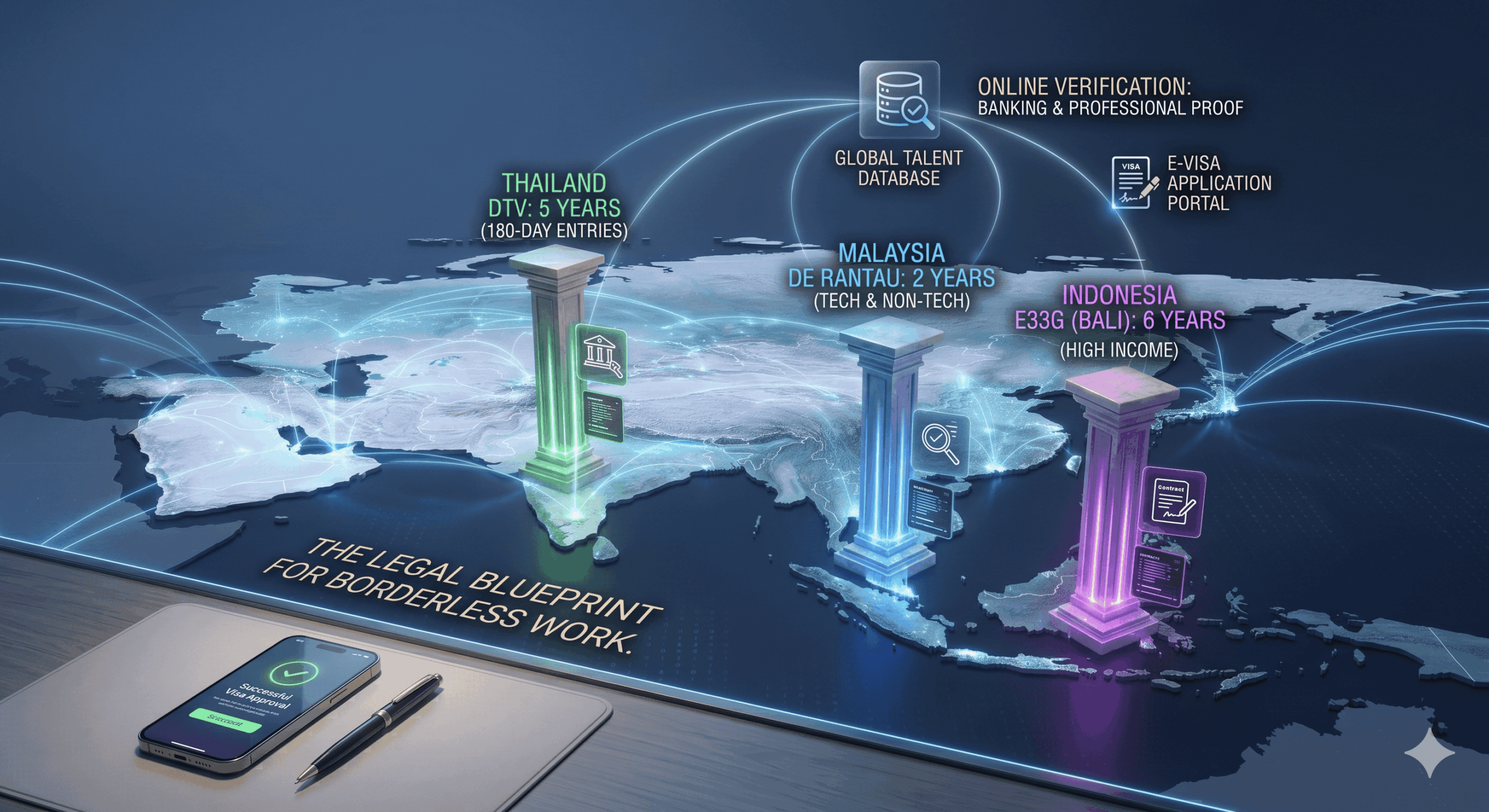
Read this article to learn more about this topic,Digital Nomad Visas in Asia: The Complete 2026 Guide
Digital Nomad Visas in Asia: The Complete 2026 Guide
The map of remote work has been entirely redrawn. The days of balancing your laptop on your knees while executing border runs every 30 days are officially over. In 2026, Asian governments have shifted from tolerating digital nomads to actively competing for them, creating structured, legal, and highly attractive long-term remote work visas.
Whether you are an AI Workflow Architect looking to base yourself in the high-density tech scenes of Southeast Asia, a Fractional Executive managing multi-currency retainers, or a seasoned developer seeking lifestyle arbitrage, Asia’s 2026 visa ecosystem offers unparalleled legal clarity.
This comprehensive guide breaks down the top digital nomad visas in Asia, their exact requirements, and how to leverage them to build an unshakeable, borderless business base.
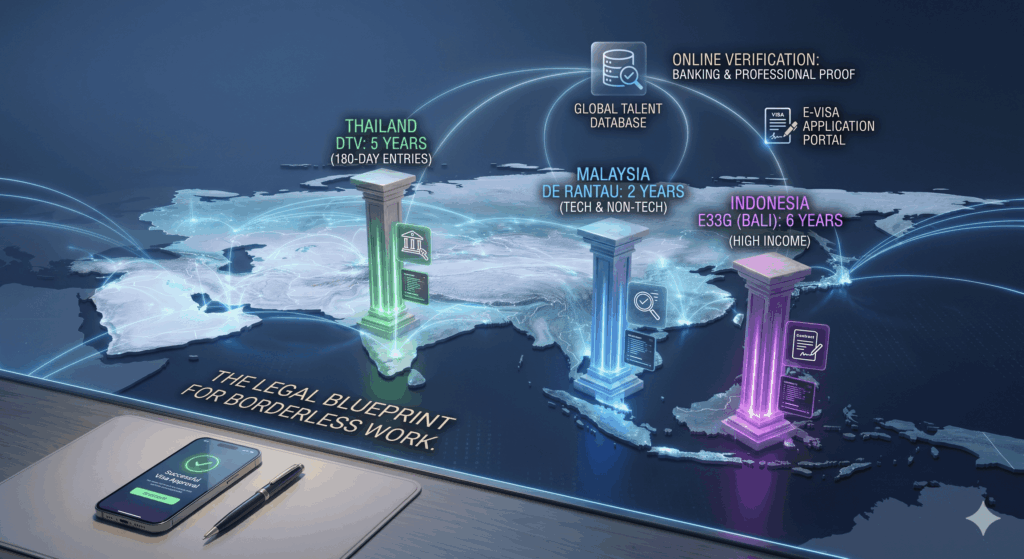
1. Thailand: The Destination Thailand Visa (DTV)
The Destination Thailand Visa (DTV) is the undisputed crown jewel of remote work visas in Asia for 2026. After clearing initial regulatory hurdles following its launch, the DTV has stabilized into the most cost-effective long-stay option in the region.
- The Big Picture: It is a 5-year multiple-entry visa.
- The Stay Duration: You are granted up to 180 days per entry. You can extend this stay in-country once per entry for an additional 180 days by paying a nominal fee of 1,900 THB (~$50). This means you can stay in Thailand for nearly a full year without ever leaving.
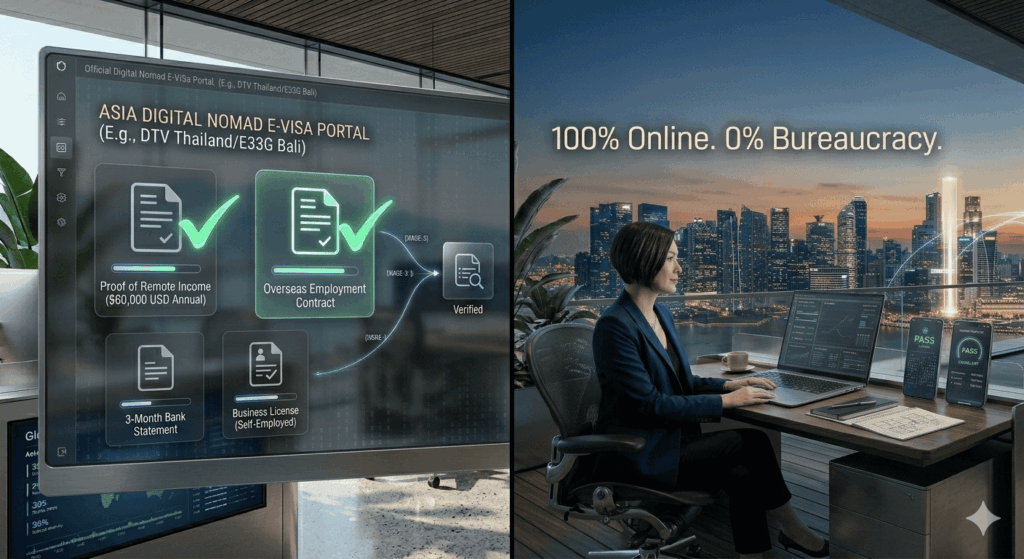
- Financial Requirement: You must show proof of liquid savings of at least 500,000 THB (~$14,500 USD) held in a bank account.
- The Professional Proof: You must submit a valid employment contract with an overseas company, a registered business license (if a founder), or a structured professional portfolio with past invoices (if a freelancer).
- The “Soft Power” Alternative: In 2026, language schools no longer qualify for the DTV. However, you can still secure a DTV by enrolling in a certified 6-month program for Muay Thai, Thai cooking, or medical treatments.
- Tax Position: You are legally authorized to work remotely for overseas clients/employers. You are not permitted to work for local Thai companies.
2. Malaysia: The DE Rantau Nomad Pass
Malaysia offers one of the most operationally stable and well-supported digital nomad ecosystems through its DE Rantau program. Administered directly by the Malaysia Digital Economy Corporation (MDEC), this is a “Premium Lifestyle” pass.
- The Big Picture: Valid for 3 to 12 months, with a straightforward option to renew for an additional 12 months (2 years total).
- The Income Split (New for 2026): Malaysia has implemented a dual-tier income requirement based on your specific industry:
- Tech Professionals (AI, Software Engineering, Blockchain, Digital Marketing): Minimum annual income of $24,000 USD.
- Non-Tech Professionals (Consultants, Fractional Executives, Marketing Managers): Minimum annual income of $60,000 USD.
- The Infrastructure Multiplier: The DE Rantau pass is more than a visa sticker. It grants you access to a curated network of verified “Nomad Hub” accommodations, certified co-working spaces across Kuala Lumpur and Penang, and local networking events.
- Tax Position: You generally trigger tax residency if you stay past 182 days. However, income generated entirely outside of Malaysia remains tax-exempt for residents—making it an exceptionally efficient base for global earners.
3. Indonesia (Bali): The E33G Remote Worker Visa
Bali remains the spiritual and entrepreneurial capital of the location-independent movement. Indonesia has formalized its dedicated remote work pathway, replacing the old, ambiguous business visas with a strict, high-income residency setup.
- The Big Picture: A highly lucrative residency permit allowing you to live and operate out of Indonesia for up to 6 years (with renewable increments), with the right to bring dependents.
- Financial Requirement: This is a high-earning tier. You must show proof of a regular annual income of at least $60,000 USD generated outside Indonesia, backed by a bank statement showing a minimum of $2,000 USD held consistently over the last three months.
- The Operational Environment: Perfect for high-ticket freelancers and agency owners who want to embed themselves in the elite entrepreneurial communities of Canggu or Uluwatu while accessing modern fiber networks and networking events.
4. Japan & South Korea: The East Asian Strategic Hubs
For freelancers looking for hyper-modern infrastructure, safety, and cultural immersion, East Asia has finally opened its doors with specialized short-term nomad programs.
Japan Digital Nomad Visa
- Duration: 6 months (Non-extendable; reapplication is allowed only 6 months after your initial visa expires).
- Income Requirement: Exceptionally high—requires an annual income of at least 10 million JPY (~$65,000–$70,000 USD).
- Best For: Independent consultants or enterprise engineers who want a high-octane, 6-month deep-dive sprint across Tokyo, Kyoto, and Fukuoka.
South Korea “Workcation” Visa
- Duration: Up to 2 years (Initial 1 year, extendable for an additional 1 year).
- Income Requirement: Requires a minimum annual income equivalent to roughly $65,000 USD (double the Korean GNI per capita).
- Best For: Tech-focused freelancers who want flawless, ultra-fast internet connectivity and want to experience Seoul’s hyper-connected, modern urban core.

Summary Comparison: The 2026 Asia Nomad Visa Matrix
| Country / Visa | Max Duration | Financial Floor | Best Suited For… |
| Thailand (DTV) | 5 Years (180-day entries) | $14,500 liquid savings | Freelancers, No-Code devs, budget optimizers |
| Malaysia (DE Rantau) | 2 Years | $24k/yr (Tech) | $60k/yr (Non-tech) | SaaS founders, copywriters, system engineers |
| Indonesia (E33G) | Up to 6 Years | $60k/yr income | High-earning agency owners, elite creators |
| South Korea | 2 Years | ~$65k/yr income | Infrastructure purists, corporate remote workers |
| Japan | 6 Months | ~$65k/yr income | Short-term strategic sprint travelers |
Conclusion: Systemizing Your 2026 Visa Strategy
In 2026, your visa is no longer an afterthought; it is a core architectural pillar of your business.
If you are looking for long-term stability and flexible regional travel, Thailand’s DTV offers the lowest financial barrier and the longest validity. If you require legal infrastructure, tax optimization for foreign income, and corporate-grade amenities, Malaysia’s DE Rantau Pass provides the most frictionless experience.
Before hitting the submit button on any e-visa portal, remember the 2026 golden rules of global mobility: always gather clean, official 3-month bank statements (crypto accounts are rarely accepted), obtain a verified letter from your foreign employer or clear freelance contracts lasting at least 3 months, and ensure your passport has at least 6 empty pages and 14 months of remaining validity.
Choose the base that eliminates your legal stress so you can focus entirely on scaling your output.
Leave your comment