
The Ultimate Guide to Hiring Affordable Remote Talent in Asia
The global labor market has entered a mature, highly performant era of decentralized workforce architecture. For forward-thinking enterprises, sourcing talent across international borders has transitioned from a simple cost-cutting tactic to a mandatory corporate strategy for scaling operational velocity.
However, many organizations fail to capture the true return on investment (ROI) of a distributed team. The problem is rarely the talent pool itself; it is the application of outdated, localized management habits to a borderless ecosystem. To successfully tap into Asia’s premier digital talent hubs, businesses must shift from generic outsourcing to a highly targeted, structural blueprint.
This ultimate guide breaks down how to strategically navigate the Asian remote talent market, target specialized geographic clusters, and build an unshakeable, legally compliant global business engine.
1. The Modular Hiring Strategy: Target Regional Specializations
The single biggest mistake companies make is looking for an all-in-one offshore assistant who can write code, design marketing assets, and triage an inbox. In a highly automated digital economy, elite teams scale by using a “modular hiring” framework—matching specific job roles directly to the best countries in Asia for hiring developers, designers, and VAs based on national education focus, corporate infrastructure, and cultural alignment.
                    [MODULAR TALENT DEPLOYMENT]
┌───────────────────────────┬───────────────────────────┬───────────────────────────┐
│     INDIA & VIETNAM       │         MALAYSIA          │      THE PHILIPPINES      │
├───────────────────────────┼───────────────────────────┼───────────────────────────┤
│ • Backend Architecture    │ • Premium UI/UX Design    │ • Growth Marketing Ops    │
│ • AI & MLOps Pipelines    │ • High Business English   │ • Executive Assistance    │
│ • Agile Mobile/Web Dev    │ • Product Aesthetics      │ • Customer Success Mgt    │
└───────────────────────────┴───────────────────────────┴───────────────────────────┘
- Deep Tech & AI Pipelines (India): Tech epicenters like Bengaluru, Hyderabad, and Pune host an immense concentration of advanced engineering talent. This is your premier destination for Machine Learning Operations (MLOps), complex data engineering, cloud security, and backend systems architecture.
- Agile Development & Mobile Apps (Vietnam): Boasting a highly disciplined, STEM-focused workforce, Vietnam has become a global powerhouse for rapid full-stack engineering, mobile frameworks (React Native, Flutter), and automated Quality Assurance (QA) testing.
- Premium UI/UX & Creative Assets (Malaysia): Malaysia bridges the cultural design gap perfectly, ranking near the top of the region for business English proficiency. Its creative professionals are highly adept at designing conversion-focused SaaS landing pages, fintech interfaces, and corporate rebrands that align cleanly with Western market aesthetics.
- Contextual Operations & Executive VAs (The Philippines): With a completely bilingual population and deep Western cultural intelligence, the Philippines remains the gold standard for outcome-driven virtual assistance, CRM data hygiene (HubSpot, Salesforce), and high-touch customer success workflows.
2. Implement a Zero-Trust Sourcing and Vetting Funnel
The explosion of conversational AI utilities and decentralized talent networks has made traditional resume screening obsolete. Hiring managers must defend their organizations against identity fraud, deepfaked initial screenings, and “ghost freelancing”—where a high-level engineer passes your technical interview but quietly sub-contracts the daily execution to unverified, low-skilled workers.
To secure your intellectual property and guarantee talent reliability, route all incoming candidates through an automated, multi-tiered verification funnel.
The Vetting Blueprint:
- The Identity Interlock: Require all candidates to complete a basic Know Your Customer (KYC) check before a formal evaluation begins, matching a live webcam interview feed directly against an official government-issued ID passport scan.
- The Live Sandbox Sprint: Never hire an independent consultant based entirely on a portfolio. Execute a live, recorded technical evaluation. Watch developers refactor code or engineers solve a complex data scenario in real time using collaborative workspace platforms to verify true cognitive logic.
- Automated Integrity Scans: Treat all submitted test assignments and initial project artifacts with absolute zero-trust protocols. Run automated screenings using code integrity engines (like SonarQube or Snyk) and advanced plagiarism scanners to check for hidden vulnerabilities, stolen logic blocks, or unverified AI-generated text.
3. Structure Performance-Indexed Milestones
Exposing your business cash flow to large, unearned upfront deposits with international contractors creates unnecessary financial risk. Legitimate, high-performing remote professionals welcome structured, transparent, and output-indexed compensation layers.
The Payment Formula:
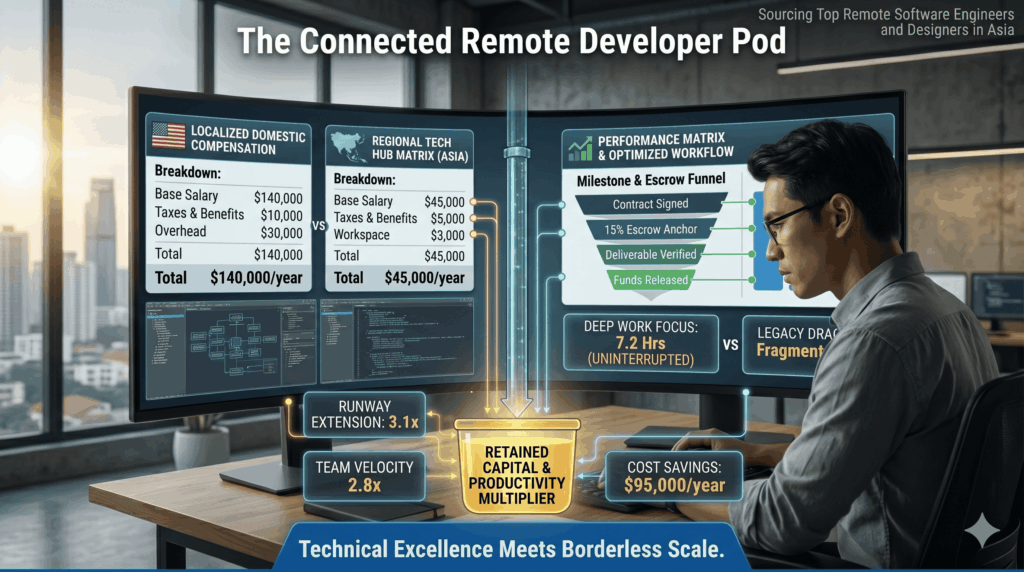
Break your project scopes or initial trial periods down into distinct, highly trackable milestones. Utilize secure escrow platforms or automated digital invoicing tools where capital is securely partitioned and only released when a verifiable project artifact is pushed directly to your corporate repositories or tracking systems.
| Project Stage | Financial Allocation | Verifiable Deliverable Artifact |
| Milestone 1 (The Anchor) | 15% of total budget | Complete wireframes, system architectural design, or strategic brief. |
| Milestone 2 (The Build) | 35% of total budget | Core functional alpha version pushed to staging environment or repository. |
| Milestone 3 (The Review) | 35% of total budget | Clean execution of automated QA debugging, UI/UX asset adjustments. |
| Milestone 4 (The Handoff) | 15% of total budget | Final deployment, clean source code transfer, and living documentation updates. |
4. Operationalize the Asynchronous “Follow-the-Sun” Engine
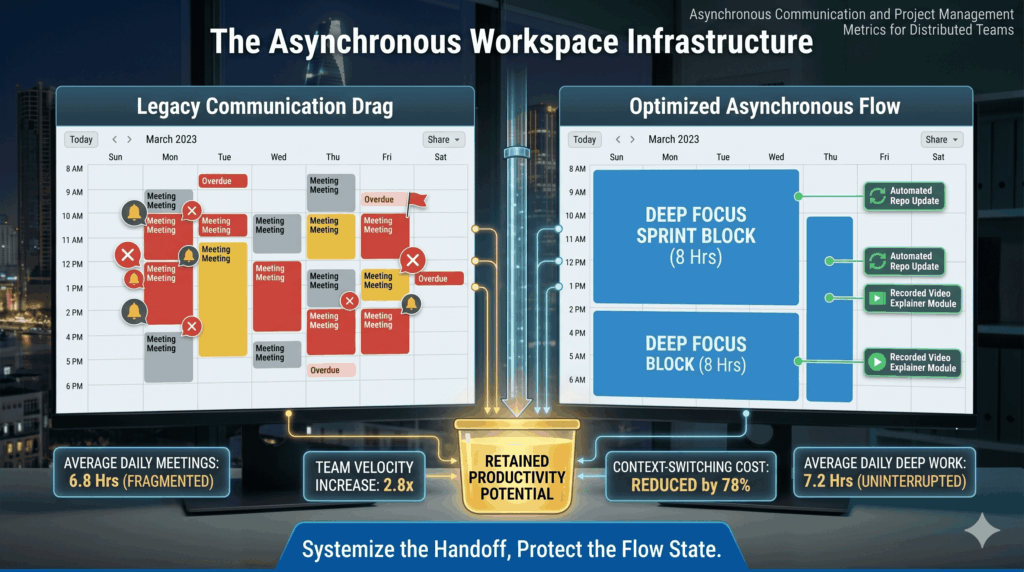
Attempting to run a globally distributed remote workforce using legacy, synchronous management habits—such as forcing an engineer in Asia to sit on a live alignment meeting at midnight their local time—destroys employee retention and introduces massive operational drag.
Top-tier organizations flip global time-zone offsets into an incredible competitive advantage by shifting entirely to Asynchronous Workflows.
The Handoff Architecture:
Divide your operational schedules into two distinct blocks. During the daytime, your remote talent in Asia operates in an uninterrupted Deep Work Flow State, completely free from Slack pings, unexpected calendar invites, and management micro-disruptions.
As their regional day concludes, they execute a clean code or asset handoff via centralized project management systems (like Linear or Notion), attaching a brief, 2-minute Loom video walk-through summarizing their technical progress. When your domestic team logs on in the morning, they open a fully updated repository with zero scheduling friction—compressing a traditional 3-week product development loop into a single calendar week.
5. Leverage Institutional Compliance Shields (EOR)
Navigating the highly localized, complex labor codes, cross-border tax withholdings, currency conversion rules, and intellectual property (IP) protection laws of multiple foreign nations can quickly overwhelm a domestic HR or legal department.
To completely eliminate international legal friction, scale your hiring using global compliance infrastructure networks, commonly known as an Employer of Record (EOR).
[Your Company] ➔ Unified B2B Contract ➔ [Global EOR Platform] ➔ Manages Local Laws/Taxes ➔ [Distributed Asian Talent]
By partnering with enterprise-grade EOR platforms (such as Deel, Remote, or Oyster), the compliance network functions as your legal proxy on the ground. The platform manages fully compliant localized payroll distribution, processes mandatory regional benefit allocations, handles local tax authority filings, and executes airtight, jurisdiction-compliant international IP Assignment agreements. This allows you to onboard top-tier global talent legally in under 48 hours, keeping your entire operation clean, protected, and infinitely scalable.
Conclusion: Value Density over Cheap Labor
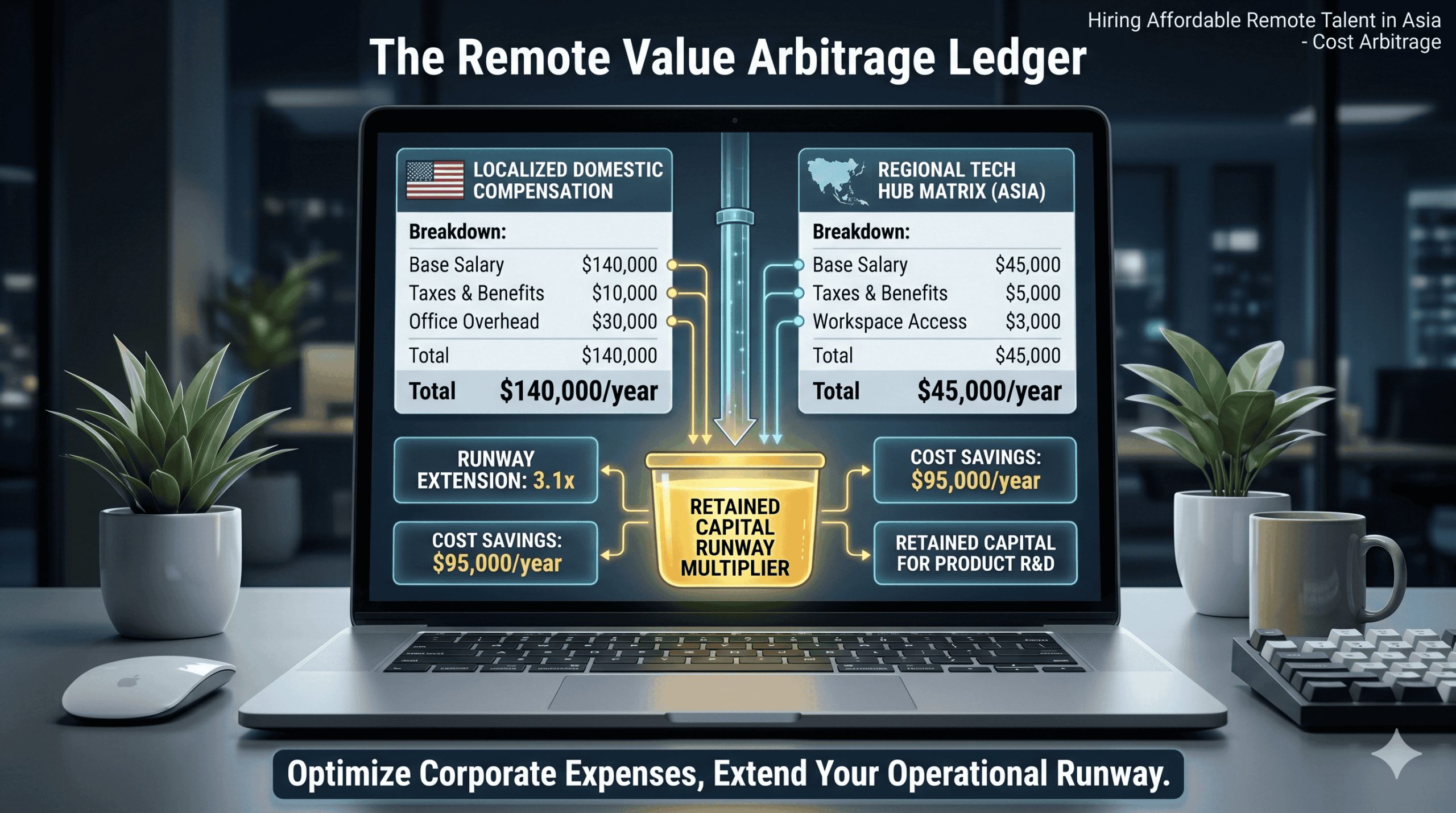
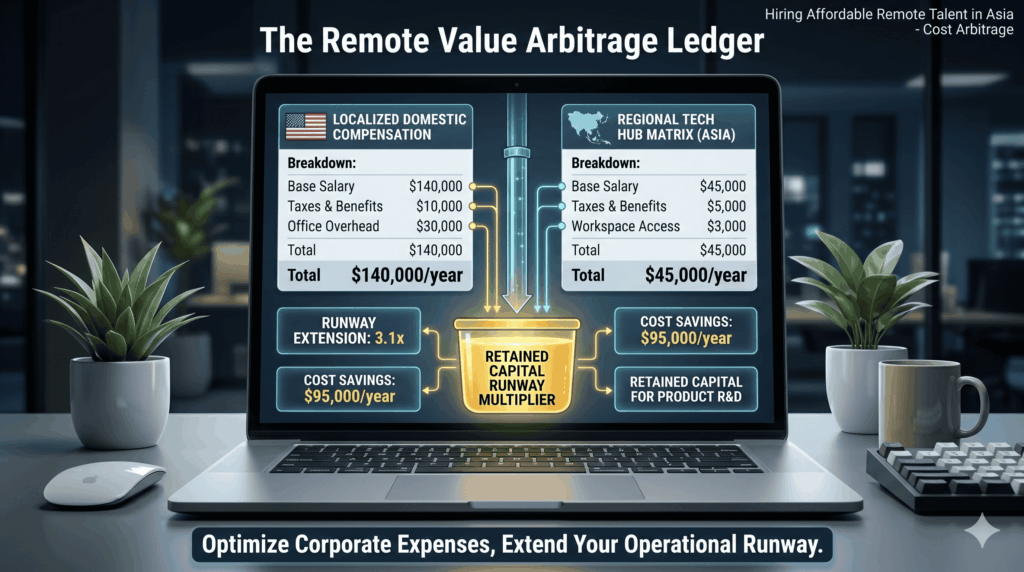
Hiring affordable remote talent in Asia is not about chasing the lowest possible hourly wage; it is a calculated corporate strategy to maximize Value Density. By decoupling your human capital compensation from domestic urban real estate inflation, your business dramatically extends its operational runway.
When you compress your structural overhead through strategic geographic arbitrage, you free up massive capital surpluses that can be directly reinvested into aggressive growth funnels, customer acquisition, or deeper product research. Take the pressure off your internal team, build an airtight operational infrastructure, and let a continuous, borderless talent engine drive your business velocity.
Leave your comment