
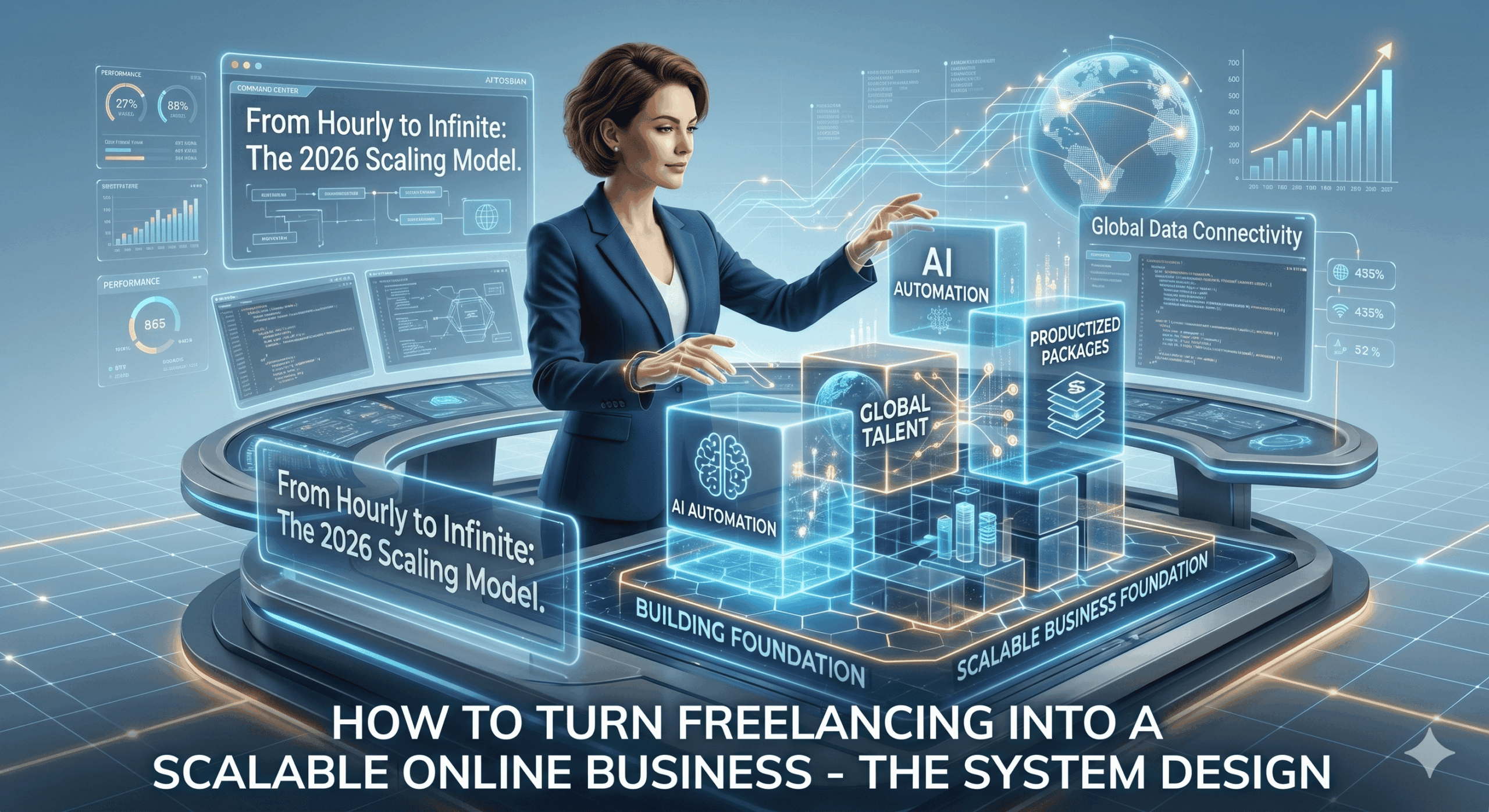
See more details in this article about,How to Turn Freelancing Into a Scalable Online Business
How to Turn Freelancing Into a Scalable Online Business
In 2026, the ceiling for freelance earnings has been shattered. The “lone wolf” freelancer who trades hours for dollars is being replaced by the “Micro-Agency Architect”—a professional who utilizes AI orchestration, global talent networks, and productized service models to build a scalable empire.
If you find yourself hitting a wall where you can no longer accept new clients without sacrificing your sleep, you aren’t just a busy freelancer; you are a business owner in need of a scalable blueprint. Here is the 2026 guide to evolving from a service provider into a scalable online business.
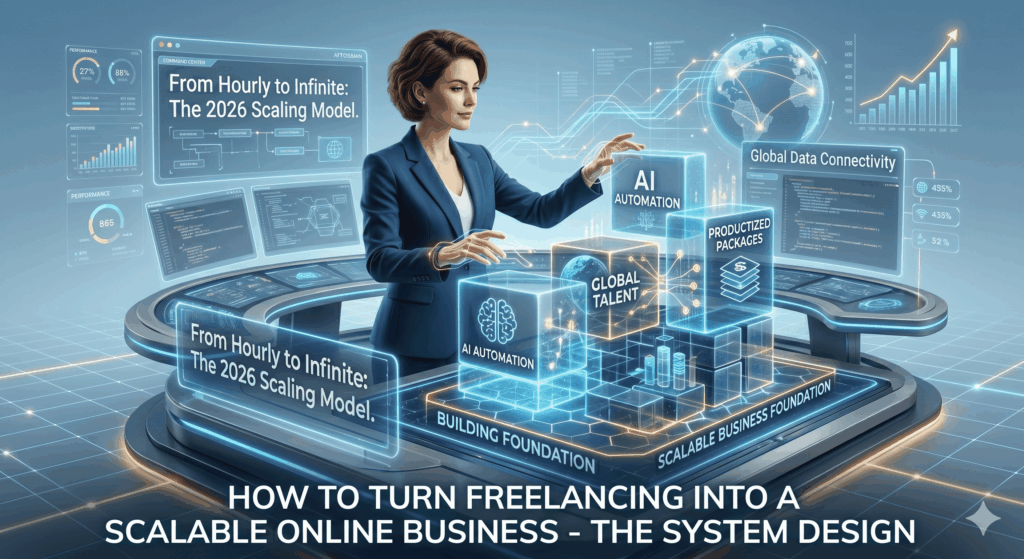
Part I: The Mindset Shift—Stop Trading Time
The first barrier to scaling is the “Hourly Trap.” In 2026, clients no longer pay for your time; they pay for Outcomes and Velocity. If you can solve a $10,000 problem in two hours using your proprietary AI stack, you should not be billing $200.
1. The Value-Based Pricing Pivot
Scalable businesses decouple revenue from labor. Instead of saying, “I charge $100 per hour,” your proposal should state, “The investment for this Lead Generation Engine is $5,000.” This allows you to scale your income as you become more efficient through technology.
2. The Founder vs. The Doer
To scale, you must move from being the “primary producer” to the “lead architect.” This means your primary job is no longer writing the code or designing the logo—it is building the system that ensures the code or logo is delivered at an elite standard every time.
Part II: Productize Your Expertise
The “Shocking Truth” of 2026 scaling is that custom proposals are a silent profit killer. Every custom proposal requires non-billable hours for research, pricing, and negotiation.
1. The Service-as-a-Product (SaaP) Model
Turn your services into “packages” with fixed prices, fixed deliverables, and fixed timelines.
- Instead of: “Custom SEO consulting.”
- Try: “The 30-Day SEO Jumpstart: 10 keyword targets, 5 optimized pages, and a technical audit for $2,500.”
2. Tiered Subscription Models
The most scalable businesses in 2026 rely on Recurring Revenue. By offering tiered monthly retainers (e.g., Basic, Pro, Elite), you create predictable cash flow that allows you to hire and invest in tools with confidence.
Part III: The AI-First Operational Stack
In 2026, your “team” includes both humans and AI agents. To scale, you must automate the “administrative friction” that eats up 40% of a freelancer’s week.
1. Automating the Client Journey
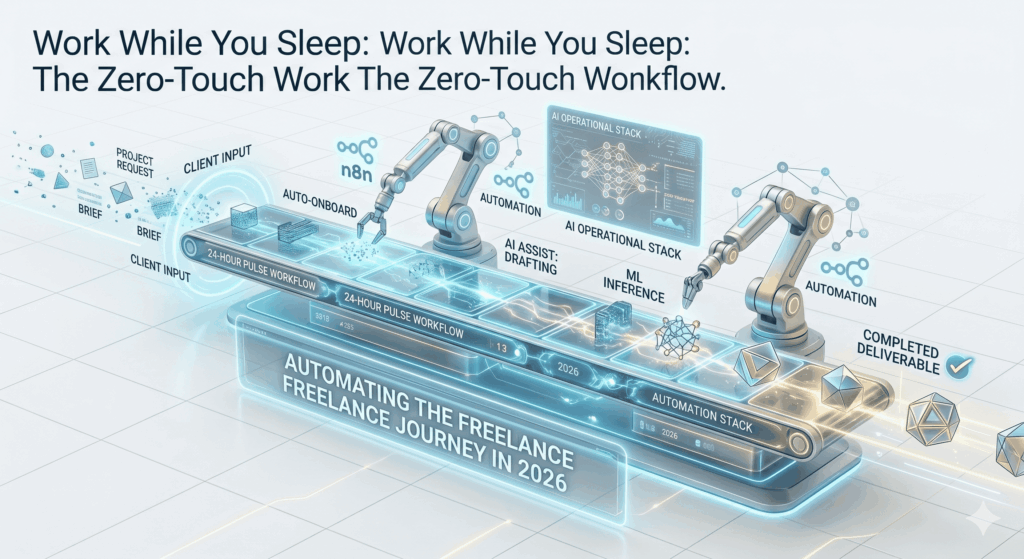
Use tools like n8n or Make to build a “Zero-Touch” onboarding process:
- Step 1: Client pays the invoice via Stripe.
- Step 2: AI automatically creates a Slack channel and a Notion project board.
- Step 3: A personalized “Welcome Video” (generated by AI) is sent with a link to a project kickoff form.
2. AI-Augmented Production
Utilize AI Agents to handle the heavy lifting of research, drafting, and initial debugging. This allows you to act as the “High-Level Editor,” ensuring that the final 10% of the work—the part that provides the real “human” value—is flawless.
Part IV: Building Your Global “Elastic” Team
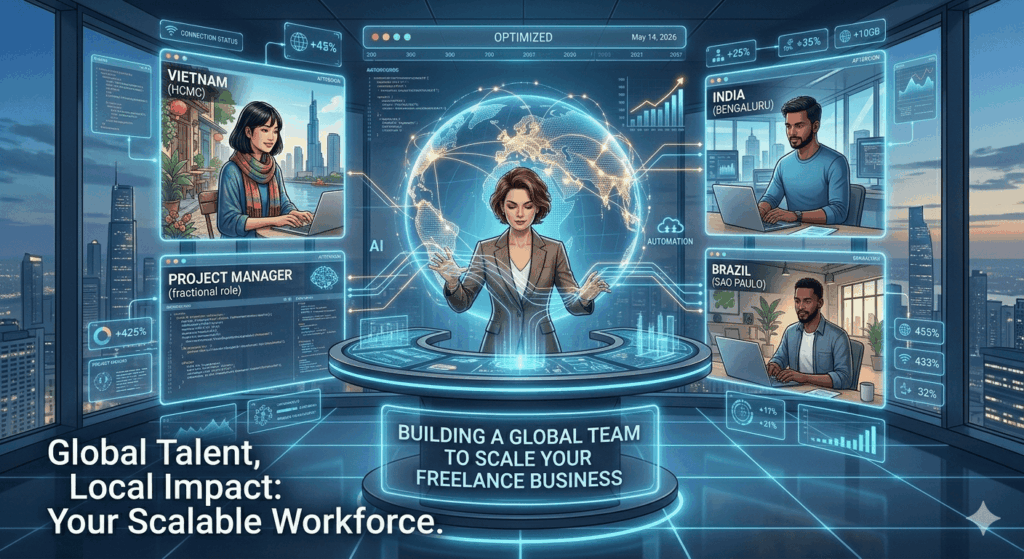
Scaling doesn’t mean hiring 20 full-time employees and renting an office. In 2026, it means building an Elastic Team of specialized international freelancers.
1. Hiring for the “80/20”
Identify the tasks that take up 80% of your time but only contribute to 20% of the value. For a designer, this might be resizing assets or finding stock photos. Hire a specialist from a hub like the Philippines or Vietnam to handle these “Production” tasks, leaving you free to handle the “Strategy.”
2. The “Fractional” Management Layer
As you grow, hire a Fractional Project Manager. For 5–10 hours a week, this person manages the communication between you, your freelancers, and your clients. This is the single most important hire for a freelancer looking to step back from the daily grind.
Part V: The Growth Engine—Inbound Authority
A scalable business cannot rely on manual outreach or bidding on platforms. You need a System for Attraction.
1. The “Proof of Work” Portfolio
In 2026, CVs are dead. Founders look for “Public Proof.” Publish case studies that show exactly how you solved a problem.
Example: “How we reduced client CAC by 40% using AI-driven ad creative.”
2. Content as a Salesperson
Your social media and newsletter should act as an automated sales team. By sharing your “Architectural Logic” publicly, you attract clients who already believe in your method, making the sales call a mere formality.
Conclusion: The Era of the Solo-Corporation
Turning freelancing into a scalable business is about moving from “What can I do?” to “How can this be done?” By productizing your services, automating your operations with AI, and leveraging global talent, you can build a business that earns like a corporation but maintains the freedom of a freelancer.
In 2026, the most successful online businesses aren’t the ones with the most employees; they are the ones with the best systems.
Leave your comment