
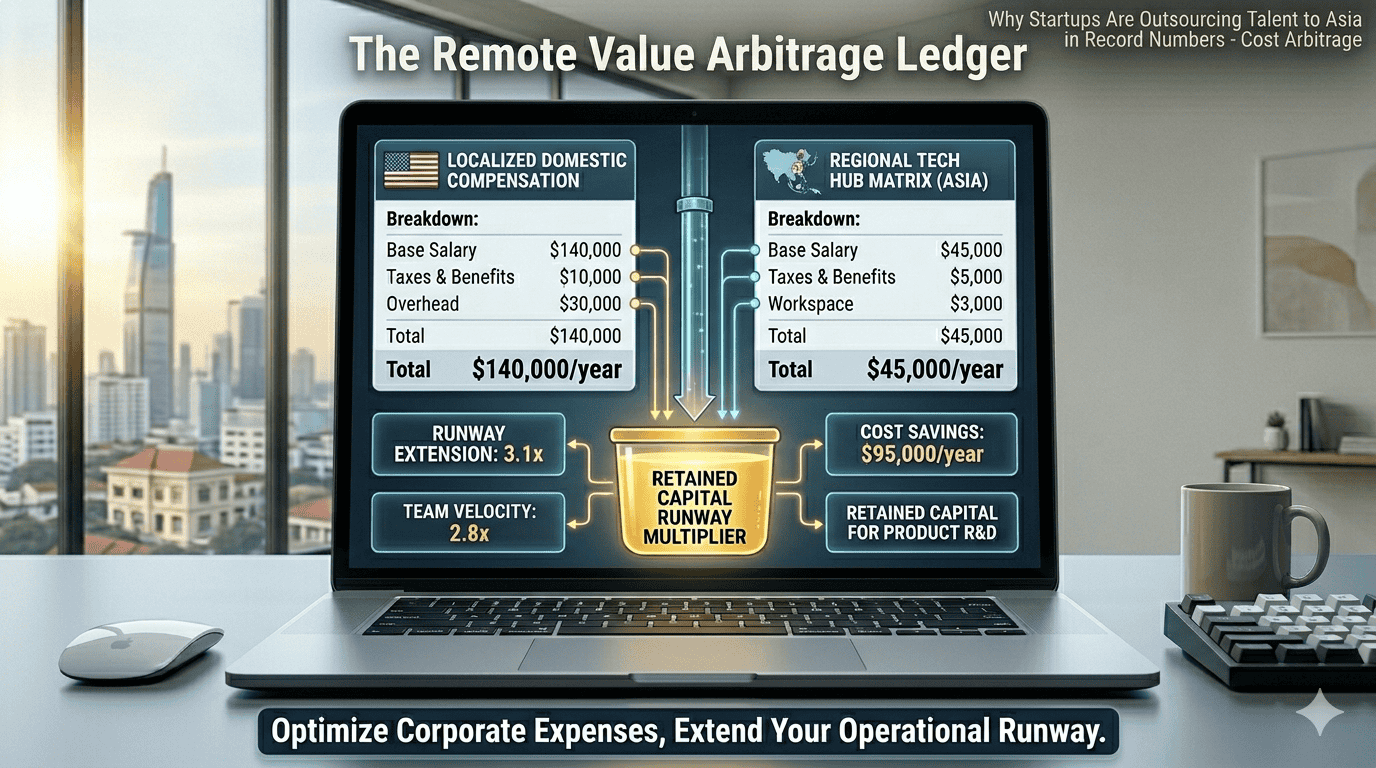
1. Radical Cost-to-Runway Optimization
The leading cause of early-stage business failure is running out of cash. Sourcing high-level technical or creative talent in premium Western tech centers forces founders to absorb immense compensation packages. Crucially, those domestic rates don’t just pay for the individual’s skill; they heavily subsidize the high living costs and real estate inflation of cities like San Francisco, New York, or London.
Hiring independent professionals and dedicated teams in Asia allows founders to decouple human capital compensation from localized domestic inflation.
An enterprise can source an elite full-stack developer or machine learning specialist in a rising regional center. By offering a rate that places them in the top 10% of their local market, you secure exceptional loyalty and elite execution while capturing an immediate 60% to 70% reduction in total structural labor costs. This allows startups to turn a fragile 6-month runway into an 18-month cushion.

2. Operating a Continuous 24/7 “Follow-the-Sun” Engine
Traditional localized startups operate on a rigid, linear, 8-hour workday. When the domestic office closes, product development often stalls. Smart founders eliminate this downtime by building a continuous, 24/7 Follow-the-Sun Operational Engine.
By strategically embedding teams across Asia-Pacific time zones, your business velocity never stalls. When your domestic product team logs off, they push clean parameters and code blocks to an incoming development squad in Asia. This structural distribution compresses a traditional 3-week product development loop into a single calendar week.
3. Targeted, Hyper-Specialized Talent Clusters
Driven by massive national investments in digital infrastructure, different Asian nations have evolved into highly specialized clusters. Founders deploy a Modular Hiring Strategy:
- Deep Tech & MLOps (India): Unparalleled density of data engineers and AI integration specialists.
- Agile Web & Mobile (Vietnam): A global center for high-velocity front-end development and automated QA.
- Premium Brand UI/UX (Malaysia): Designers who excel at crafting conversion-focused SaaS interfaces.
- Growth Operations (Philippines): The capital for client-facing virtual assistance and growth marketing.
4. Forced Evolution to Asynchronous Operational Excellence
Hiring talent in Asia forces your business to master asynchronous workflows. Smart founders replace live meetings with structured documentation hubs and Loom video walk-throughs, ensuring uninterrupted blocks of time for deep focus work on both sides of the globe.
5. Scaling via Compliance Shields (EOR)
The fear of navigating complex cross-border compliance is dismantled by Employer of Record (EOR) Platforms. Startups can legally onboard full-time distributed employees across Asia in under 48 hours, with EORs handling localized payroll, regional benefits, and IP assignment agreements.
Summary Matrix: The Outsourcing Impact
| Metric | Legacy Startup (Domestic) | Modern Startup (Asian Outsourcing) |
|---|---|---|
| Labor Costs | High (includes local inflation) | Efficient (60-70% lower) |
| Development Cycle | 8-hour workdays | 24/7 Follow-the-Sun |
| Operations | Synchronous/Meetings | Asynchronous/Documented |
Conclusion: The Distributed Corporate Mandate
Outsourcing talent to Asia is an intentional strategy to build a modern corporate architecture. By optimizing capital runway, capitalizing on a 24/7 production engine, and anchoring operations inside an asynchronous compliance shield, startups transform into lean, continuous enterprises engineered to out-execute the market.
Frequently Asked Questions (People Also Ask)
What are the best countries in Asia to outsource software development?
India and Vietnam are currently leading the market for technical talent. India offers an unparalleled density of data engineers and AI specialists, while Vietnam has rapidly become a global center for high-velocity front-end development and mobile app engineering.
How much does it cost to hire a developer in Asia vs. the US?
Hiring a senior developer in the US typically costs between $120,000 and $160,000 annually. In contrast, hiring a top-tier developer in Southeast Asia or India ranges from $30,000 to $50,000 annually. This represents a 60% to 70% reduction in structural labor costs without compromising on execution quality.
Leave your comment