

1. The 5x Execution Framework: Overcoming the Linear Time Barrier
The primary operational ceiling for traditional freelancers is their direct, linear relationship with time. If a web developer requires six hours to build out an application layout from scratch, or a copywriter needs four hours to complete an in-depth research brief, their monthly income is artificially capped by the number of hours they can physically work per day.
AI completely breaks this time-to-output bottleneck. Across modern creative and technical workflows, AI handles 70% to 80% of repetitive, routine execution, transforming the freelancer from a manual laborer into a high-level conductor.
[Traditional Freelancer] ➔ Manual First Drafts & Pixel Pushing ➔ Capped 8-Hour Output
[AI-Enabled Freelancer]  ➔ 30-Second Baseline Gen + 15-Minute Human Edit ➔ 5x Project Capacity
By leveraging advanced reasoning engines (such as ChatGPT-4o and Claude 3.5) alongside specialized content accelerators, freelancers can bypass the friction of the “blank page syndrome” entirely. What used to take half a workday of source-gathering and framework design is compressed into 30 minutes of deep prompt refinement. This 5x speed advantage allows an independent professional in Southeast Asia or South Asia to comfortably take on five times the traditional client volume without proportionally scaling their working hours or inducing cognitive burnout.
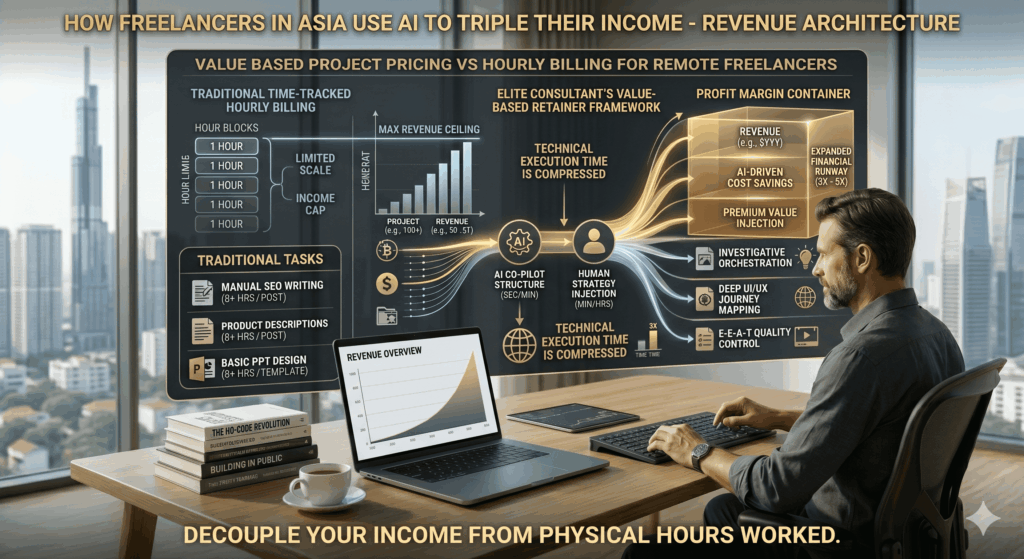
2. Breaking the Hourly Wage Ceiling with Value-Based Pricing
Freelancers who continue to quote hourly rates are actively penalizing themselves for adopting efficient technology. If an AI tool or prompt library allows you to finish a client’s e-commerce audit or landing page code framework in one hour instead of five, your gross revenue collapses by 80% under an hourly framework.
The top 10% of earners in Asia have abandoned hourly tracking apps in favor of Value-Based Project Pricing or Fixed Monthly Retainers.
- The Mindset Shift: Global corporate clients do not care how many hours a freelancer spends sitting at a desk; they care exclusively about problem-solving speed, data reliability, and bottom-line business outcomes.
- The Profit Margin Multiplier: An AI integration specialist or digital designer can confidently quote a premium fixed fee to build a custom customer-onboarding pipeline. Because their prompt infrastructure and backend tools allow them to execute the technical heavy lifting in record time, their effective hourly earning rate multiplies exponentially. They pass the benefits of speed to the client while capturing immense profit margins for themselves.
3. Dominating the Fastest-Growing AI Skill Verticals
Tripling your income requires moving away from highly saturated commodity gigs and positioning yourself inside hyper-specialized, high-growth skill brackets.
AI Integration and Prompt Architecture (+178% Growth)
- What they do: Integrating large language model APIs (OpenAI, Claude, Perplexity) directly into a client’s existing digital workspace.
- Median Market Rate: $120 – $200 / Hour.
AI Video Generation and Editing (+329% Growth)
- What they do: Utilizing advanced motion and neural rendering engines (such as Runway Gen-3, Kling AI, Luma Dream Machine, and Descript) to generate and edit high-end marketing clips.
- Average Payout: $800 – $2,500 per completed project.
Autonomous Chatbot & Agent Development (+71% Growth)
- What they do: Building conversational web helpers that manage 24/7 customer support and inbound sales leads using builders like Voiceflow and Botpress.
- Average Payout: $2,000 – $15,000 per system deployment.
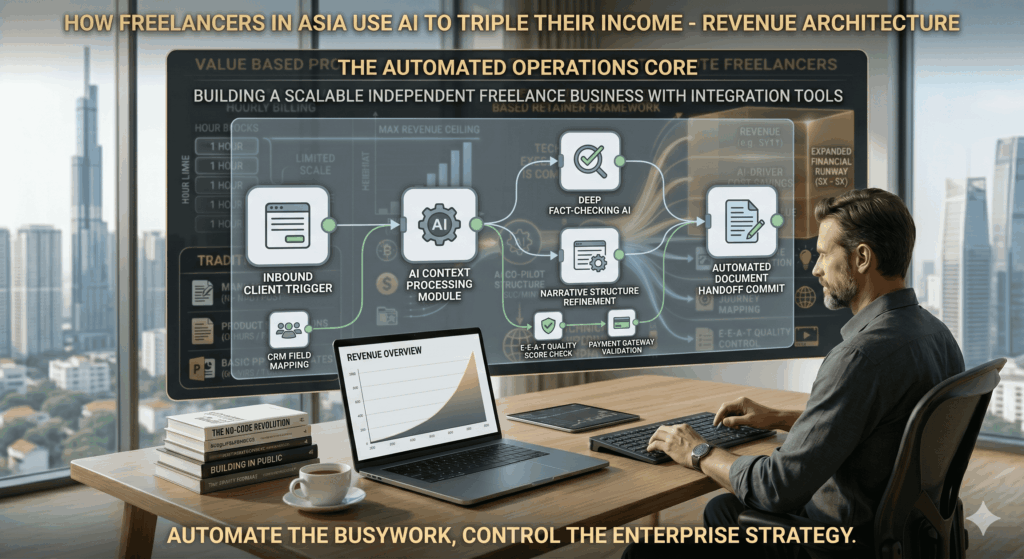
4. Step-by-Step Guide: How to Transition from Executor to AI Director
- Step 1: Conduct a Commodity Audit: Identify any task you perform that can be solved by an AI tool in under 60 seconds and mark these as “automation targets.”
- Step 2: Master Prompt Engineering: Invest time in learning how to feed deep context, user personas, and brand style guides into AI engines.
- Step 3: Secure Budgets via Escrow: Lock your project milestones in our platform’s secure Escrow system before starting the project workflow.
- Step 4: Execute Quality Control: Add your human value: verify data accuracy, refine emotional nuances, and ensure technical specifications are met before delivery.
5. Budget Dynamics: Reinvesting in Your Technology Stack
To discover how to balance these software investments while protecting your baseline margins, review our study on optimizing budgets for digitalized IT projects.
6. The Human Differentiator: Empathy, Context, and Business Intuition
An AI model lacks two critical components: empathy and context. You act as the strategic translator. By handling client relationships with high emotional intelligence, transparent communication, and deep care, you build a premium brand that software can never replicate.
7. Intellectual Property Safety and the Clean Content Mandate
Our marketplace provides automated NDAs and clear IP transfer terms. Every project handled on the platform guarantees that custom-refined property belongs exclusively to the buyer once funds are released from escrow, providing a liability shield for both parties.
8. Frequently Asked Questions: Mastering Cross-Border Talent Integration
Will AI lower market rates? For commoditized tasks, yes. For strategic freelancers who use AI to deliver high-impact results, rates are increasing.
How do I explain AI usage to my clients? Frame it as a competitive efficiency advantage: “I use AI tools to accelerate production, allowing me to focus on high-level strategy and quality control.
Is AI work safe for sensitive data? Yes, provided you use professional tools with privacy modes that do not use your input to train public models.
9. The Modern Cross-Border Workflow: Seamless Data and Capital Protection
[ Unstructured Client Problem ] ---> Human Discovery & Strategic Scope Planning
                                                       |
                                        Contextual Prompting & AI Engine Generation
                                                       |
[ Expert Human Refinement (You) ] <--- Rigorous Quality Vetting & Liability Check
     |
     +------------> Secure Marketplace Delivery ------------> [ Immediate Escrow Payout ]
10. Operational Breakdown: The Value Transformation Profile
| Skill Profile | Old Approach (Low Value) | Strategic Approach (High Value) |
| Software Engineer | Repetitive code blocks | Architecting systems & managing AI pipelines |
| Content Marketer | Manual article writing | Intent modeling & strategy |
| Graphic Designer | Stock vector editing | Creative direction & UI/UX strategy |
11. Scaling from Individual Freelancer to Solopreneur Agency
Using the AI tools mentioned, a single freelance operator can handle the client volume of a five-person agency. You become a project director, leveraging AI as your virtual workforce. To master the logistics of running a distributed, automated business model, explore our complete blueprint on efficient coordination of independent specialists.
12. Action Terminal: Pivot Your Portfolio Today
Take command of your independent financial path. Set up your specialized freelancer account, structure your service offerings into premium, high-value Gigs, and let our smart matchmaking algorithm align your profile with global businesses ready to pay top dollar for true human expertise.
Leave your comment